‘Like Jesy Nelson’s twins, I have SMA. I want to show you can live a full life and be disabled’
Kelly Gordon, 36, was diagnosed with Spinal Muscular Atrophy Type 3 aged 2
A mother-of-two living with Spinal Muscular Atrophy (SMA) has powerfully declared she "wouldn’t trade my disability," aiming to demonstrate that individuals with disabilities can lead full, meaningful, and successful lives.
Her message comes as the condition recently gained public attention after former Little Mix star Jesy Nelson revealed her twin daughters were diagnosed with it.
Kelly Gordon, 36, received her diagnosis of SMA Type 3 – a less severe, yet life-altering form of the condition – at the age of two.
She maintained the ability to walk until she was 11, at which point she transitioned to a full-time power chair user. Reflecting on her experience, Ms Gordon stated she "wouldn’t change that journey, because it’s given me so much strength and understanding of myself and other people."
SMA Type 3, like other forms of the condition, is characterised by progressive muscle weakness and mobility problems. However, individuals with this specific type often maintain their independence for longer periods than those diagnosed with Type 1 or 2.

Ms Gordon, who is based in the West Midlands, has had what she describes as a “mainstream life”, attending a mainstream school and enjoying playing with her friends as a child. She often needed to adapt playground games she wanted to play, but as a child she struggled to accept the progressive nature of her condition.
“But the fact is, you’re a child working against a progressive condition, and actually, I wouldn’t change that journey, because it’s given me so much strength and understanding of myself and other people,” she told PA Real Life.
“I’m very, very grateful for that, which sounds like a very strange thing to say, but it’s true.
“I can’t even imagine what person I would be if I didn’t have a disability.”
Ms Gordon’s family had no history of SMA, and she was only tested for the condition because her brother, who is 18 months her junior, was not meeting his expected milestones at six-months-old. Both Kelly and her brother were diagnosed with SMA Type 3.
Neither of her sons, now aged five and eight, have SMA, but they will be carriers of the genetic condition.
For Ms Gordon, SMA mainly affects her standing and walking, and she has weaker arms and limited hand dexterity. She can stand, with assistance from her husband, and usually uses a hoist to transfer her to and from her power chair.
“It just kind of depends on the day, and it depends how much energy you’ve got, how much you’ve used your body as well,” she explained.
“I find with myself, because I’m busy, I’m always working, I’m always travelling, my body can, after a few days, sort of feel the impact of that and then get quite fatigued.”
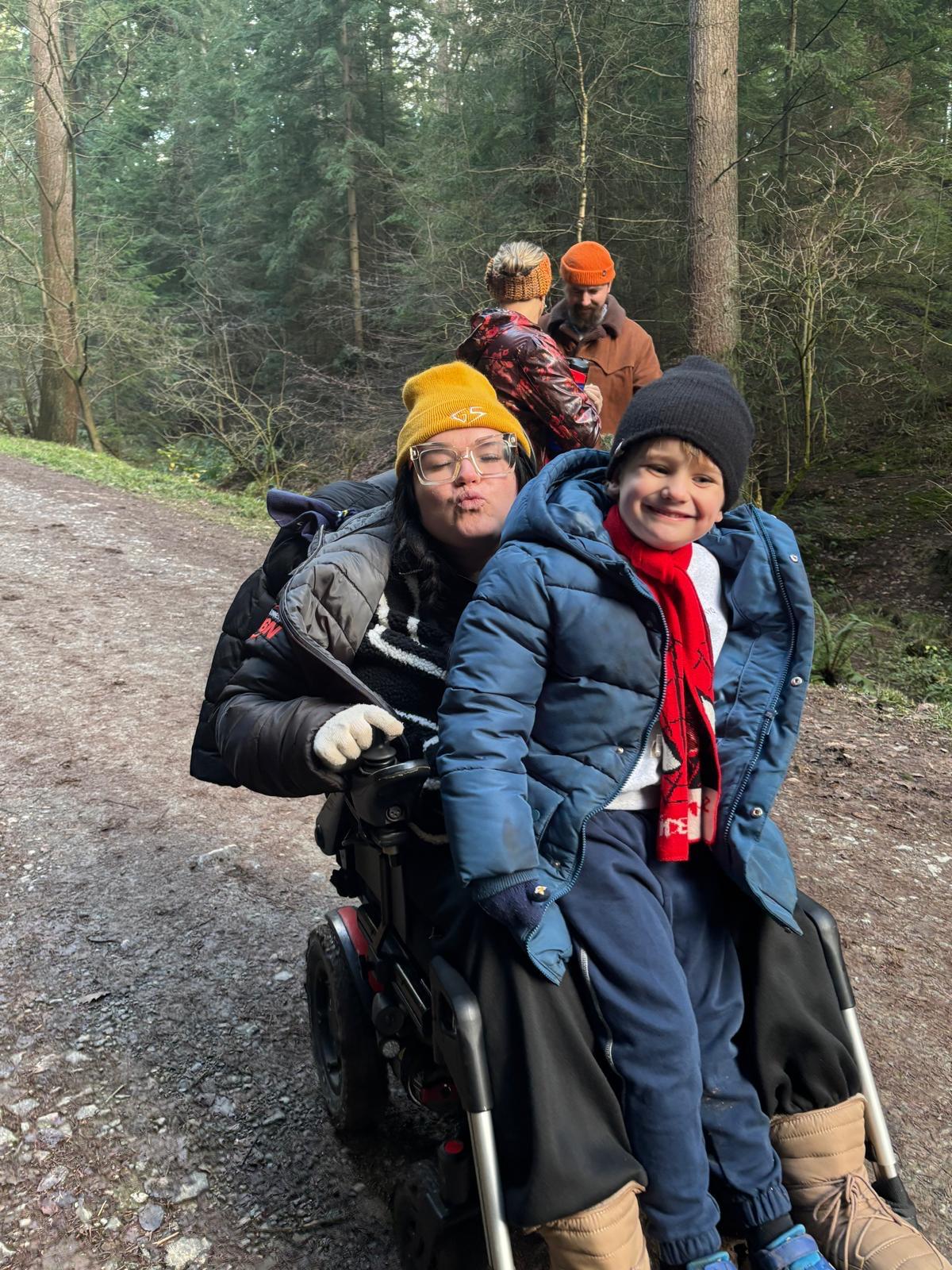
Ms Gordon’s successful career certainly keeps her busy. She has her own production company With Not For, which solely represents disabled talent and works with advertising agencies and mainstream media enterprises across the UK.
“Everybody on our books, whether they’re off screen creatives or on screen talent, in terms of models, actors, whatever – everybody has a disability,” she said.
“Even with our internal team, we make sure that everybody is disabled, because we bring that unique perspective.”
Kelly and her business partner Emma Gardner started With Not For during the Covid pandemic, having met online and connected over a desire to bring more disabled people into creative spaces. Since the company was founded in 2020, they’ve worked with Channel 4, Guinness, the Six Nations, and huge advertising agencies.
“Our main goal is to change the way disabled people are viewed within the media,” she said, adding that she wants to tackle the narrative that disabled people aren’t successful, that they have a lesser quality of life, “because ultimately, that’s not true”.
“We’re often let down by society, and that’s a real shame, because things aren’t accessible to us, even attitudes aren’t accessible sometimes. But me and my business, we’re really trying to change that.”
Kelly notes how the narrative around disability, particularly in the mainstream media, tends to fall at two ends of a spectrum.
“One end of the scale is like, it’s really sad to be disabled. You stay at home all the time. You just go to medical appointments,” she said.
“And then the other side is you’re a Paralympian, you’re so successful, you’re inspirational, blah, blah, blah. There’s nothing in between.”
Following the news of Jesy Nelson’s twins being diagnosed with SMA, Ms Gordon wants to show the world that a disability doesn’t have to mean a restricted life.
She recognises that Jesy’s daughters have Type 1, a more severe type of SMA, but she wants to “bring a greater understanding to the world that disability isn’t sad”.
“Being a person, no matter if you’re disabled or not, is an incredibly beautiful and amazing experience, and it doesn’t mean that Jesy’s going to love her children any less,” she said.
“It doesn’t mean that her children are going to be any less incredible or successful or interesting or funny.”
Bookmark popover
Removed from bookmarks