Trump may be down in the polls – but he is certainly not out of November’s election
Watching the president lurch from crisis to crisis, though, I half wonder whether his heart is really in this race, writes Mary Dejevsky

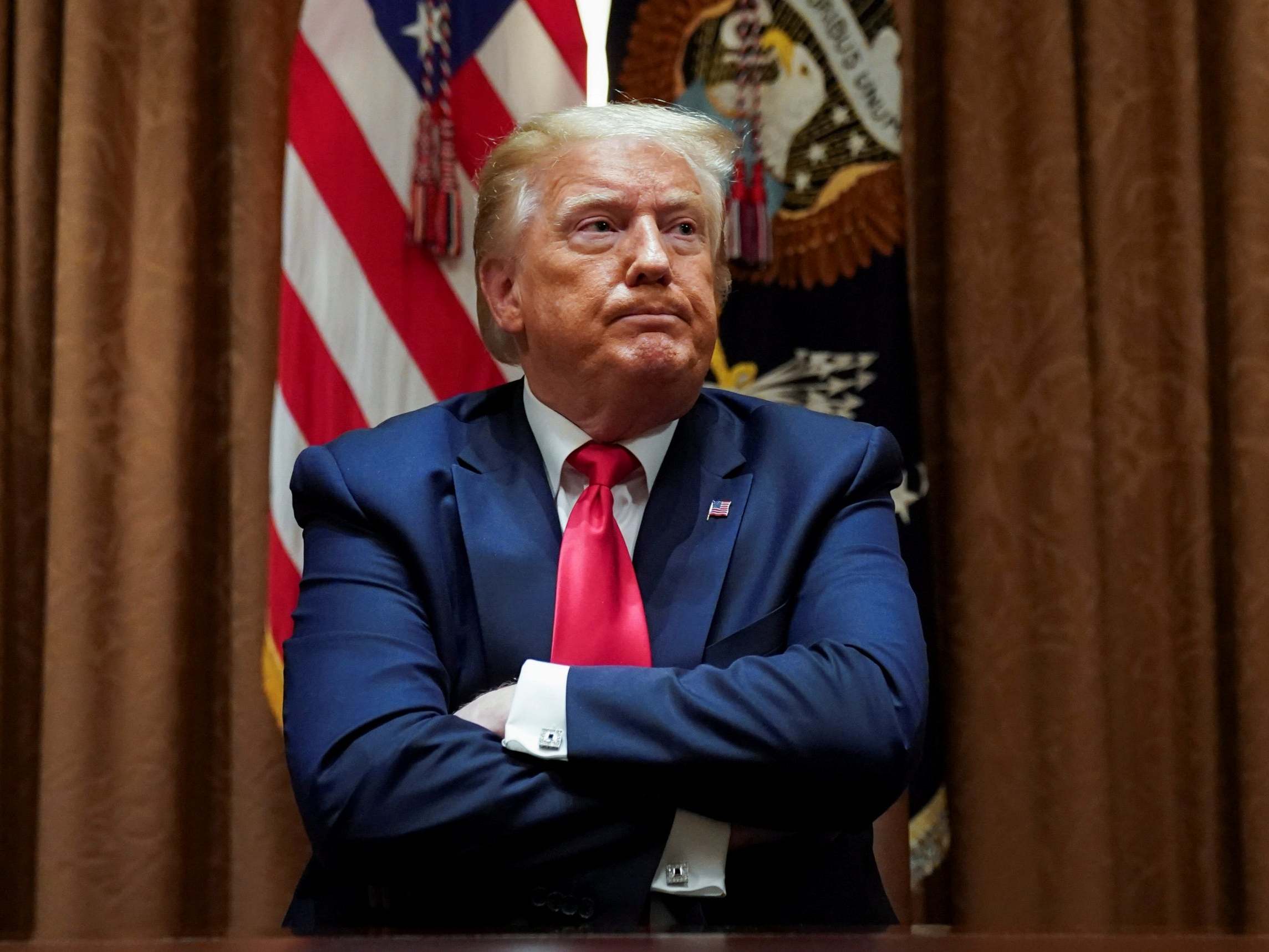
If Donald Trump fails to win a second term as US resident in November, then the first 10 days in June could be seen as the pivotal point. Having remained remarkably stable for many months, the polls are all moving in the same direction, and not in his favour.
Former vice president Joe Biden, who has just obtained the requisite number of delegates to secure the Democratic Party nomination, is said to be in a stronger position as challenger than any candidate since Bill Clinton in the summer of 1992. (And we know what happened that November.)
Trump is not indifferent to polls. He has a thick skin in many respects, but not in respect to the opinions of voters. So shocked was he by the latest CNN poll that put him 14 points behind Biden – 55 to 41 per cent, with a disapproval rating of 57 per cent – it was not so out of line with other polls as to suggest either major inaccuracy or bias. So Trump is down, but is he out? For the president’s many detractors on both sides of the Atlantic, it is a tempting conclusion to draw.
For many Americans in what might be called the elite – on both sides of the political divide as well as independents – Trump has never really been a legitimate president. They still cannot conceive of how he managed to be elected (hence the lingering appeal of the saga of Russiagate). They cannot really believe that enough of their fellow citizens, having watched how he handled, or mishandled, one term in the White House, would actually hand him two.
Like many Europeans, they follow his antics with horror – in recent weeks, his flip-flopping over coronavirus, his remarks about injections of bleach, his apparent admission that he was taking hydroxychloroquine, weeks after he had praised it with no clinical proof whatsoever, his rudeness to the media, his early tone-deaf responses to the killing of George Floyd and the protests that followed – and they conclude that, if he was ever to be taken seriously, he has now demonstrated how unfit he always was for presidential office.
Not only this, but they have living examples of how things could be done so much better. The governor of New York, Andrew Cuomo, was seen by many as a model crisis leader even as coronavirus overran the hospitals in and around New York City. Joe Biden – no stranger to grief from family bereavements himself – gave a pitch-perfect response to the Floyd outrage and spoke eloquently at the funeral in Houston. It was suddenly possible to see him as president-in-waiting, after several earlier glitches on the empathy front.
Barack Obama, for his part, has now abandoned the convention that former presidents do not criticise their successors by offering characteristically well-chosen words at crucial points. The stars, it would seem, are aligning for a change at the White House in November.
With the election almost five months away, however, that looks a lot like wishful thinking. Trump may be flailing on very many fronts, but he could yet make it a contest on 3 November.
Surveys suggest that, until very recently, Trump’s core vote has remained loyal. This is in part because these Americans read what are seen by his critics as excesses in quite a different way. For Trump to attack sections of the establishment – including large sections of the east coast media – gives them a voice they have rarely had. Washington DC for them is exactly what Trump said it was when he vowed in his 2016 campaign to “drain the swamp”. Their only regret would be that he has not done enough of it.

Mostly, they know not to take his higher flights of rhetoric or fancy too seriously. They can write off his supposed advocacy of bleach against coronavirus as a fantasy hypothetical, rather than a recommendation (as misreported by many of the media). As for hydroxychloriquine, his remarks may have been ill-advised, but the possibilities of the drug for coronavirus were taken seriously by medics, and in a land far more open to self-medication than most European countries, his advocacy was treated with far less disdain than it would be here.
And, yes, Cuomo became something of an all-American hero for his daily briefings on the pandemic, and maybe Trump could have earned some national credit by being seen to take a competent lead. But not to have done so will not have reflected as negatively on him as it might have done for a national leader elsewhere.
One reason why is that Trump has taken the lead on China. For him to dub the coronavirus as the “Chinese virus” may have been instinctive – and crude – but it was also electorally shrewd, playing in to longstanding political and public fears. Trump’s trade challenge to China is popular, and the Democrats know it. Biden cannot afford to appear “soft” on China, but it will be hard to him to come across as tougher than Trump.
Then there is the way health is organised in the United States, where it is state governors and legislatures, rather than the president, that will be first in the firing line for poor performance. And, third, is the fact that the US response overall has not been as dire – so far – as many forecast. There is great variation between urban and rural areas and from state to state. And, although the number of coronavirus deaths in the US – at more than 110,000 – is the highest in the world, in proportion to the size of the population, the US stands ninth globally, with 345 deaths per million, almost half the rate in the UK.
This will make it harder, too, for those (mainly Democrat) Americans who believe that the US should introduce socialised medicine on the European model to make it into an election issue – with emotive TV footage to make their point.
The killing of George Floyd and its aftermath could also be less of a liability to Trump than it seemed initially. Around the world, the deployment of troops – whether the national guard or regular troops – and arguments about the constitutional authority for so doing may not be a good look for any US administration abroad. But for Republican voters in an election year, the highly visible imposition of order will hardly be a vote-loser, especially as the violence quickly subsided. The Democrats must also beware that any support for authorities, such as Minneapolis, proposing to “defund” their police, could be seized upon by Trump as evidence of laxness on crime.
The biggest danger for Trump has to be the economy. Jobs and the record stock market were at the centre of his campaign for re-election before coronavirus struck. Now, with unemployment threatening to rise to Depression levels and only the barest safety net in place, Trump will need a rapid recovery in good time before November. Measures to mitigate the potential disaster will also be the Democrats’ and Biden’s strongest suit. But generosity with tax-payers’ money rarely plays well in a US election. That is one reason Bernie Sanders lost the primaries to Biden.
So, yes, five months out, the auguries look favourable for Biden – a lot more favourable than they did even one month ago. But he is not home and dry, just as Trump is not out. There are conventions and a whole autumn of campaigning ahead.
Watching Trump lurch from crisis to crisis, though, I half wonder whether his heart is really in this race. If the poll margin becomes too wide, might he not just stamp his foot, curse the media, and walk away? Don’t rule it out, don’t rule anything out. Five months is an eternity in US politics during 2020.
Join our commenting forum
Join thought-provoking conversations, follow other Independent readers and see their replies
Comments
Bookmark popover
Removed from bookmarks