Erdogan is sure his strategy of politics cloaked by religion will consolidate his power. We shall see
Turkey’s leader is picking and choosing his way through his country’s history for the gaudiest bits to discard or embellish, writes Robert Fisk

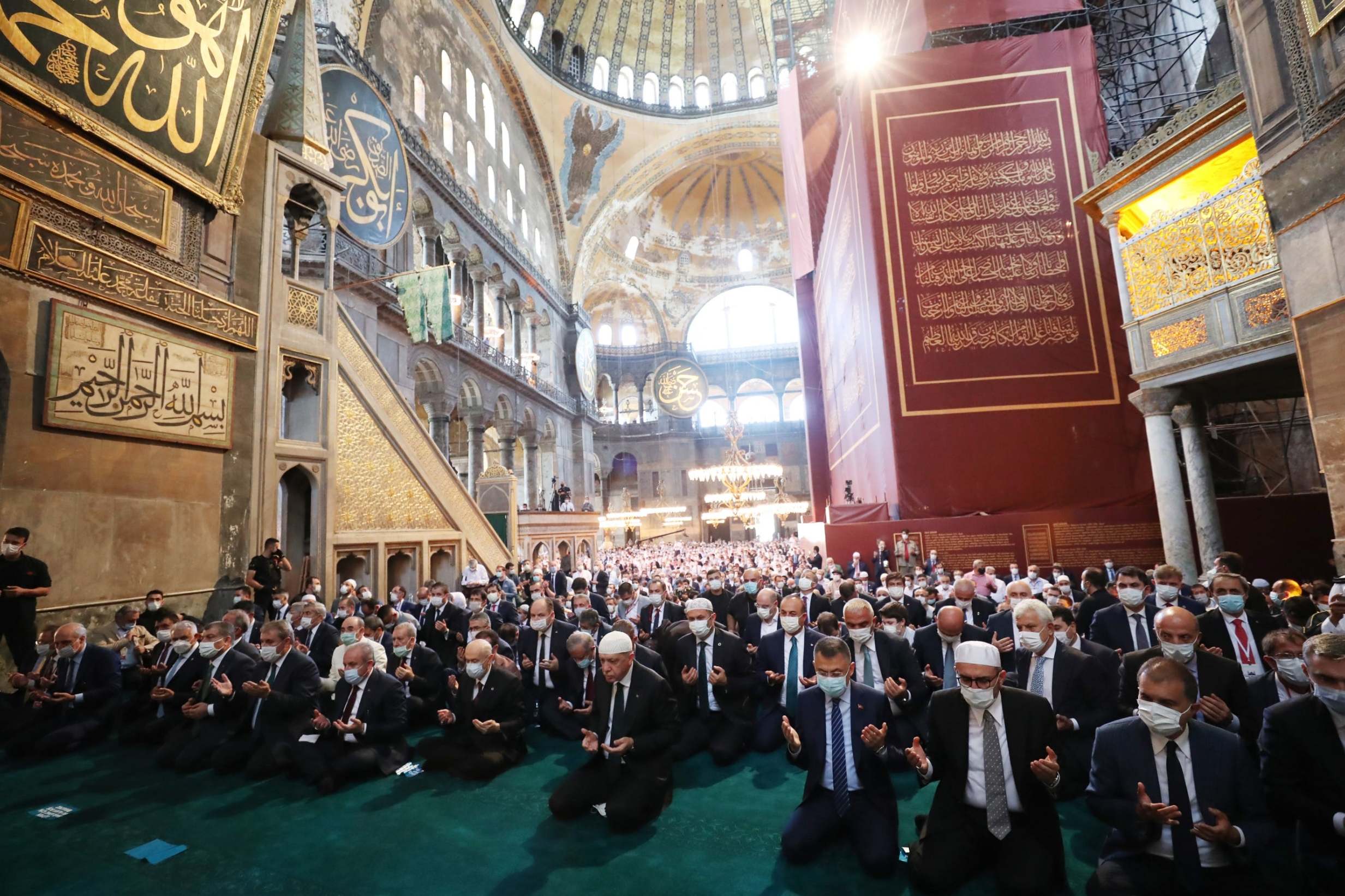
If Bashar al-Assad was the only figure able to take advantage of Recep Tayyip Erdogan’s “reconversion” of Saint Sophia into a mosque after a mere 85 years as a museum, something must be very wrong with the world’s reaction to the Turkish president’s latest political shenanigans.
After Erdogan restored the almost 1,500-year old structure – designed by its Christian builders to recreate the Temple of Solomon – to the status of a fully prayed-in, fully functioning, fully muezzined place of worship for Turkey’s Muslim majority, the Americans expressed their “disappointment”, the EU and Unesco their “regret” and the Pope his “deep sadness”.
Inevitably, only the Orthodox church rumbled on about this “threat to the whole of Christian civilisation” – though it has been tolling its misery about the loss of the church ever since the Muslims conquered Byzantium in the 15th century. In the Middle East, history lasts a long time.
But only the Syrian regime appears to have grasped the reality – that Erdogan’s chicanery was politics cloaked by religion – and thus reacted in kind. A “miniature” version of the great colossus of modern-day Istanbul would now be erected in Syria, the regime announced – indeed in the ancient Hellenistic and now majority Greek Orthodox and Christian town of Al-Suqaylabiyah in the province of Hama – with the assistance of Assad’s Russian (Orthodox) ally and as a symbol of “peaceful dialogue” between faiths.
So there you have the Ba’athist message: secular Syria, after bloodbaths galore, remains devoted to inter-faith peace and reconciliation after its titanic struggle against “world terror”, while “Sultan” Erdogan stirs up Muslim-Christian hatred in the old Ottoman empire. You’ve got to hand it to autocrats; they know how to spot another one. The Turkish leader wants to soak up the votes of his country’s urbanistas through devotion – he has the support of Turks outside the cities – while the Syrian leader wants to soak up the blood of the past nine years with a non-sectarian gesture that might assist his own international restoration.
A Turkish mystery remains, however. Does Erdogan really wish to destroy the myth of Ataturk, the modernist, pro-western, “pro-civilisational” hero of the Turkish state, and restore his country to the glories of the Ottoman nation? Or is he – the surest bet – picking and choosing his way through Turkish history for the gaudiest bits to discard or embellish according to his opinion polls.
He was – let’s give the man his due – the first to understand the importance of the Arab spring in 2011. Indeed, Arabs flew the Turkish flag as he toured the region during the revolutions, long before western leaders grasped the importance of events. Who would have imagined that the Ottoman flag, more or less, would ever fly again over the caliphate’s former empire?
There can be no doubt in Erdogan’s mind that the Ottomans presented Turkey with a nationalist “Turkdom” – unfettered by hundreds of thousands of Christians – upon which Ataturk could build. Mustafa Kemal, as the Turks called him, had no direct part in the Armenian genocide – although some of his comrades did – but the liquidation of the great Christian communities of Turkey allowed Ataturk to rule over a largely pacified nation.
The Kurds remained, for him, a cancer in the body politic over which he wished to rule – and here, indeed, is a dictatorial sickness that has infected Erdogan – but Turkey was now an almost all-Muslim country. No wonder Hitler and the Nazis treated Ataturk with such respect – and why Volkischer Beobachter fringed its front page in black when it reported his death in 1938. Turkey had already found a final solution to its minorities.
Ataturk could build new roads, railways, dams, hospitals, cities, including Turkey’s new capital, and he could thus be regarded in the western media of the time as a progressive world statesman, creator of what James Pettifer – a wonderful writer on Turkey and a past contributor to The Independent – called “a kind of beneficent Stalinism”. But he savagely repressed Islam.
Vast prisons were opened – in this, at least, Erdogan has much in common with Mustafa Kemal now that he has jailed tens of thousands of his people for supposedly supporting the attempted coup in July 2016 – and even those Ataturk laws that banned the fez in favour of the hat were enacted so strictly that several Turks were hanged over the ensuing legal controversy.
It’s not difficult to see how Erdogan’s dark and corrosive view of Ataturk came about. Women’s emancipation is not directly contested by Erdogan – save for government directives on the wearing of scarves in government offices – but his disregard for traditional, tribal, “sheikhly” society is. Listen to Ataturk, for example, speaking of Turkey in 1925. “In the face of knowledge, science, and of the whole extent of radiant civilisation,” he told a rural crowd, “I cannot accept the presence in Turkey’s civilised community of people primitive enough to seek material and spiritual benefits in the guidance of sheikhs. The Turkish republic cannot be a country of sheikhs, dervishes and disciples.” Even the Turkish law on clothing was to insist that “the hat is the common headgear of the Turkish people.” This would never come from Erdogan’s mouth.

Yet it’s tempting to believe that there’s an Ataturk “doppelganger” in Erdogan. While he may have overturned Ataturk’s 1935 decision to turn Saint Sophia (or Hagia Sofya) into a museum – and it’s as well to remember that the Muslim shields inscribed with the names of Allah, the prophet Muhammad and the caliphs that Ataturk removed were actually restored long ago (a small matter not mentioned last week) – he shares the Great Leader’s interest in vast national projects, preferably using large amounts of pre-stressed concrete. For Ataturk’s railway stations and dams, just look at Erdogan’s massive, space-age airport in Istanbul or the vast and expensive canal project, and you see the parallels.
Yet the Ottomans were of a similar mind; their railway systems – the Beirut-to-Damascus line over the Lebanese mountains, for example – were state of the art. Hence Germany’s pre-First World War involvement in building Turkish railways and stations. Ataturk did not discover western civilisation for Turkey. The Ottoman elite had learned to play Brahms and Chopin and to paint like western artists.
If Erdogan really does wish to wear the clothes of a caliph, however, then his military incursions into Syria – into Afrin and the Kurdish border areas – certainly have an Ottoman insouciance about them. His contempt for Assad is not unlike the Ottoman disdain for regional but disloyal Arab leaders who dared to oppose the Sublime Porte.
And Erdogan’s occasional scorn for Putin – a highly dangerous characteristic – has something in common with the violent Ottoman opposition to Tsarist Russia. However, the Ottomans had Britain and France on their side against Russia – and then Germany on their side when they made the final, gruesome mistake of joining the Central Powers against Britain and France in 1914. Erdogan has no one who would go to war for him.
Assad knows this as well as anyone. His Hama project may well tweak the caliph of Istanbul’s small grey moustache, but the man who embraced the Ottomans by painting the chairs of his palace in gold leaf – remember how embarrassed Angela Merkel appeared when she had to sit on one of them – has one ultimate comparison to Ataturk: the need for sole and absolute power.
Assad knows this, too. For the Turkish president, this needs popular, nationalist support – which is worth turning a museum back into a mosque. It’s called politics cloaked by religion. And you can forget the Ottomans.
Join our commenting forum
Join thought-provoking conversations, follow other Independent readers and see their replies
Comments
Bookmark popover
Removed from bookmarks