Don’t be confused – Trump’s ‘America first’ instincts are driving his coronavirus response
Despite widespread shock, EU travel ban aligns with president’s policy, writes John T Bennett

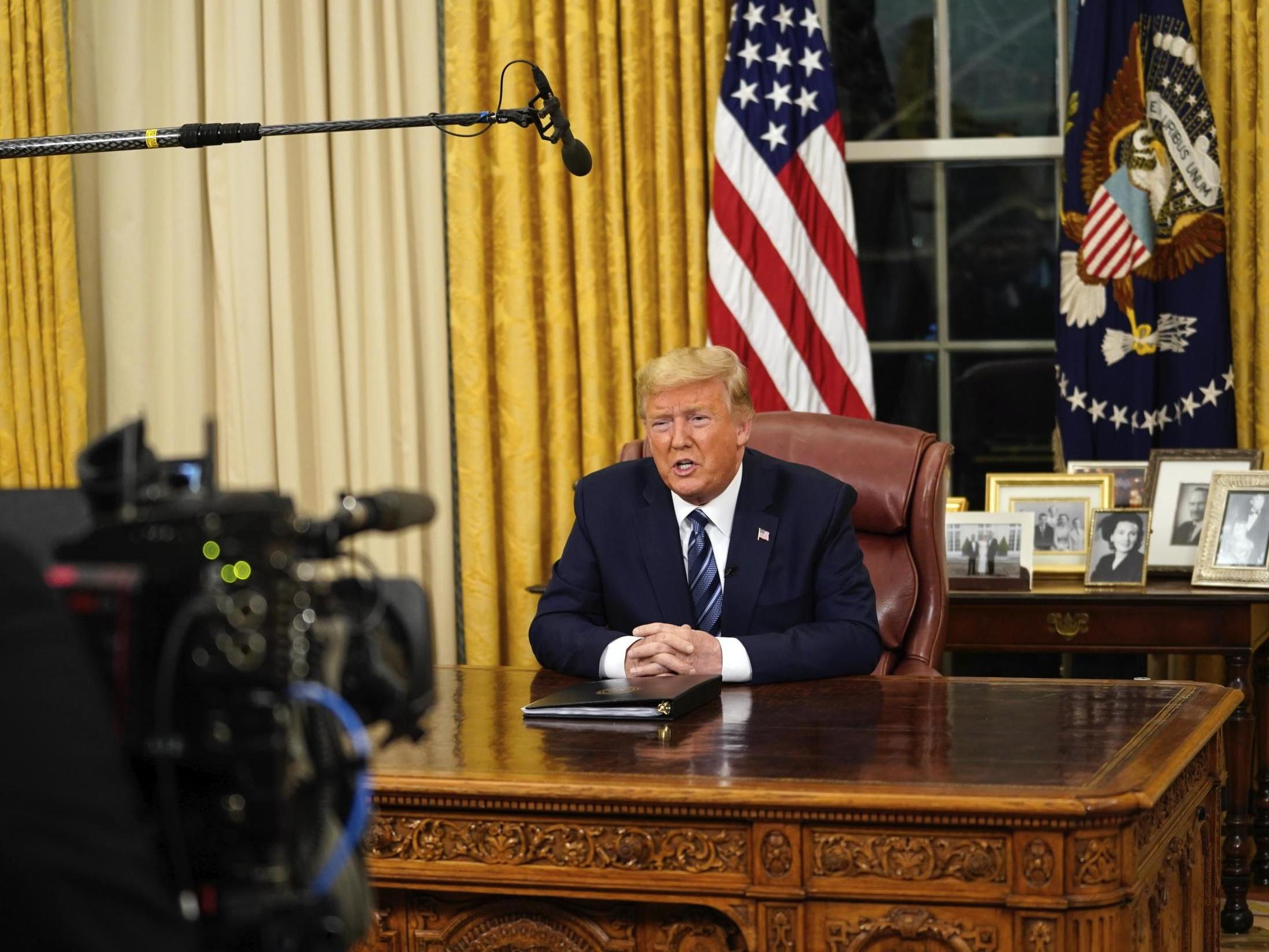
Donald Trump was out of his element on Wednesday evening behind the storied Resolute Desk in the Oval Office, reading a coronavirus speech that bred confusion, new transatlantic ill will and left many unanswered questions.
The US president spoke to the nation – the world, really – in a formal address from the historic office for only the second time. The first, to discuss a government shutdown last year and his proposed southern border wall, did not go as well as he liked, with aides acknowledging afterwards it was not his preferred speech venue.
But he flubbed key parts of the counter-virus strategy his critics say he and his public health team have been slow to craft and implement. Global and US markets responded on Thursday by again taking a nosedive; the Dow Jones Industrial Average, which is closely watched by Mr Trump, fell by 1,700 points and, for the second time this week, all trading was temporarily halted.
In a sign Mr Trump’s speech, seemingly geared as much for his conservative political base than the country as a whole, did not hit the desired mark, senior Dow Jones officials were answering questions about a trading holiday to let traders calm down – something that suddenly doesn’t seem like a far-fetched or particularly bad idea.
Part of the new financial chaos stemmed from Mr Trump’s misreading of his own speech.
“There will be exemptions for Americans who have undergone appropriate screenings, and these prohibitions will not only apply to the tremendous amount of trade and cargo, but various other things as we get approval,” Mr Trump said on Wednesday night. “Anything coming from Europe to the United States is what we are discussing.”
Only for a White House official and even Mr Trump himself to quickly clarify, via a presidential tweet, that it is “very important for all countries & businesses to know that trade will in no way be affected by the 30-day restriction on travel from Europe. The restriction stops people not goods.”
The gaffe was merely the latest for a president who, at times, has struggled to stay on message and at times appeared unwilling to offer details of his controversial policy proposals.
The European travel ban also reflected his hardline instincts on immigration and globalism.
Vice president Mike Pence was deployed to make the rounds on Thursday’s morning news programmes to defend the president’s speech and the policies he unveiled. Mr Pence, perhaps the most loyal member of Mr Trump’s cabinet and inner circle, said the commander in chief made the decision “on the spot” on Wednesday to issue the European ban after “hearing from all sides that the best thing we could do is suspend all travel”.
It was up to the vice president, a career politician who was governor of Indiana and a member of the House GOP leadership team, to explain some of the unanswered questions Mr Trump left on the freshly polished Resolute Desk. Chief among them: how will US citizens and permanent residents now in Europe get back to US soil?
“Americans coming home will be funnelled through 13 different airports,” he said. “They’ll be screened and then we’re going to ask every American and legal resident returning to the United States to self-quarantine for 14 days.”
Why Mr Trump left that out of his speech is unclear, but he is much more comfortable with tough talk – like calling the coronavirus a “foreign virus” – than wonky policy descriptions.
What’s more, the European travel ban and using that term to describe the virus aligns neatly with his “America first” policy. For a president who always has his re-election campaign on his mind, shutting down travel from Europe carries the political bonus of looking tough in the eyes of his base, which he needs to turn out in big numbers come November.
The 30-day ban also is vintage Trump in another way: he recently has shown a willingness to go directly at what he perceives is the biggest possible threat. Think Iranian major general Qasem Soleimani, the Quds Force commander the US president had killed after several attacks on American facilities in Iraq, with Democrats acknowledging the now-deceased military man was a terrorist mastermind.
The same goes for operations he ordered that killed Islamic State group leader Abu Bakr al-Baghdadi and Qasim al-Rimi, the former leader of al-Qaida in Yemen.
Europe now is the “epicentre” of the virus, with over 23,000 confirmed cases and nearly 1,000 deaths. That’s compared to over 1,200 known US cases and 37 deaths.
So, for those who have been studying the Trump presidency with an objective eye, the temporary European travel ban was no surprise. Nor should a possible extension should the virus continue to spread inside the United States, as Mr Pence predicted on Thursday morning.
In Mr Trump’s mind, banning European travellers is good politics and good policy. It’s the kind of thinking that drove his immigration-based 2016 campaign. And with the health of the US economy in question as stock markets lose value and the coming virus spread’s full effects not yet known, the “America first” president may have to focus more on a hardline immigration message than a you-are-better-off-than-you-were-four-years-ago sales pitch.
That means additional travel bans are possible. So, too, are major addresses blaming others, including Europe.
“And taking early intense action, we have seen dramatically fewer cases of the virus in the United States than are now present in Europe,” Mr Trump said before offering a possible campaign trail attack line: “The European Union failed to take the same precautions and restrict travel from China and other hotspots. As a result, a large number of new clusters in the United States were seeded by travellers from Europe.”
America first. America second. Everyone else a very distant third. Whether or not the virus will soon, as Mr Trump said this week, “go away”, his isolationist instincts won’t change.
Join our commenting forum
Join thought-provoking conversations, follow other Independent readers and see their replies
Comments
Bookmark popover
Removed from bookmarks