Au revoir Gmail and Zoom : how Macron pulled the plug on American big tech in France
As Paris bets that homegrown tech can replace Silicon Valley defaults across government, Chris Stokel-Walker asks whether other countries, including Britain, will follow suit

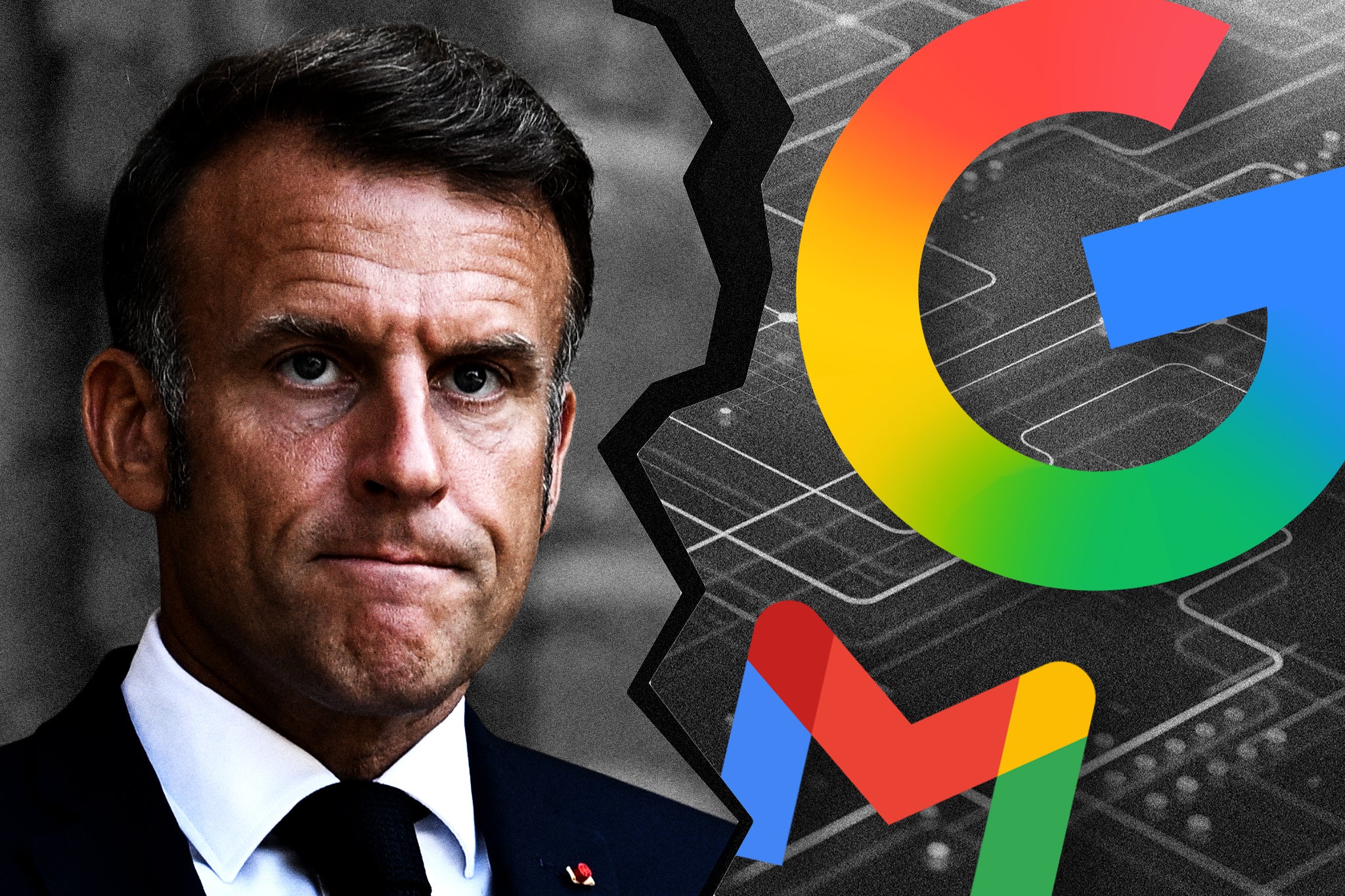
Apps and platforms designed and maintained by US-based companies dominate our lives. This story was written in Microsoft Word and researched using Google Chrome. It was emailed using a Gmail account, overseen by the search engine’s parent company, Alphabet, from interviews conducted on Microsoft Teams and Zoom.
It can feel impossible to escape the overenthusiastic, American-accented grasp of big tech platforms in our digital lives. But with increasing uncertainty coming out of the Donald Trump White House, and an America First strategy that some fear puts profit first, at the expense of people, some are making a more concerted effort to try and wean themselves from American dominance.
Last month, the French government announced plans to stop using Microsoft Teams and Zoom in favour of its homegrown alternative, Visio, by 2027. Alongside that, the French government also has a range of other European alternatives to popular tools including Slack and Gmail. It’s a bold move to try and remove reliance on US tech, and it augurs a broader discomfort about overreliance on a handful of companies that some believe have caused more harm than done good during their existence.
“France clearly wants to take back control of its IT, data and its future,” says Steen Dalgas, a senior cloud economist at Nutanix, a cloud computing firm. “It's not alone: data sovereignty is a big ongoing shift among technology powerbrokers.”
Paris has been testing Visio for around a year and already has roughly 40,000 regular users on the platform, with plans to scale to about 200,000 civil servants in the next phase before it becomes the default across all ministries by 2027. Visio itself sits on a “sovereign cloud” run by Outscale, a subsidiary of the French software corporation, Dassault Systèmes. The state has already pushed officials off WhatsApp and Telegram and onto its own secure messaging app, Tchap, built on the Matrix protocol.
“France has a long history of seeking its own tech destiny,” says Dalgas. That includes the development of Minitel, a pre-internet network operated by state telecoms operator France Telecom, which was founded in the 1980s and eventually shut down in 2012.
Part of the decision-making is down to money: internal estimates suggest that France could save €1m (£870,000) a year in licensing fees to US big tech firms for every 100,000 public sector users it ports over to Visio. But it’s also a recognition that the world has become too reliant on a handful of US big tech firms, and under Donald Trump’s presidency, those companies have become perceived as – even if they aren’t actually – less reliable partners.
At its core, sovereignty is about which jurisdiction ultimately applies to data and how easily organisations can be compelled to disclose it. Europe has historically been very forward-thinking and interventionist in trying to protect privacy and be more self-sustainable. Individually, it’s incredibly difficult for rank-and-file citizens to take action that makes a difference, because a single person can’t have that much power over companies’ bottom lines. But if a whole continent or country withdraws their custom from a business, it has a much bigger impact.
And it’s needed, many argue. America’s stranglehold on our tech is significant: three major American hyperscaler companies account for two-thirds of the European cloud storage market. At the same time, Europe’s voice in that market has become weaker: its share has dropped from 27 per cent in 2017 to just 15 per cent today. The problem isn’t just in national governments or private companies, either: the European Commission, which has been one of the most strident critics of US big tech overreach, uses European-based companies for just 1 per cent of its own cloud systems, with the remaining 99 per cent being run by US-based firms.
The impact of a decision within Europe, with its 450 million consumers, could have an outsized impact, experts reckon.
“If Europe stops being a captive market, US firms lose pricing and political power,” says Tommaso Valletti, professor of economics at Imperial Business School. But he says that such a shift wouldn’t happen overnight. Instead it would happen “marginally at first, but structurally over time”. It would also require careful co-ordination among countries to stand strong against what is a powerful big tech lobby within Europe in order to avoid fragmentation, says Valletti.
That will require some determination and the avoidance of the temptation to fold at the first sign of difficulties. “It can work if Europe accepts likely short-term inefficiencies for long-term autonomy,” he explains.
But what happens to the UK now that it’s outside of European auspices post-Brexit? The fragmentation of tech into different spheres is a risk that could impact us here at home, says Marc Warner, CEO and co-founder of Faculty, a UK AI firm. That’s especially the case because of past inaction that has put us in an invidious position.
“In the mid-2000s, the UK failed to invest in domestic cloud computing,” says Warner. “Our own cloud provider would be ideal to run things like national security and defence computation on. But the cloud ship has sailed. We are now reliant on big tech, and UK sovereign control is weaker for it.”
Warner worries that the same is happening in the AI space, too, pointing to homegrown AI titans in Europe like France’s Mistral and Germany’s Helsing. “Governments are explicitly choosing to foster sovereign capability alongside foreign investment,” he says. “If we are not careful, AI will follow the same path, crowding out domestic firms capable of sovereign alternatives. While foreign investment is welcomed, we must ask if we are building a foundation for UK companies and the UK economy to thrive.”
That’s something motivating Stephen Kelly, CEO of data specialist Cirata, who has spent 40 years championing the UK tech sector through homegrown giants including Sage. “France’s move highlights a reality the UK needs to confront,” he says. “We are materially locked into US technology across critical layers of our digital infrastructure, particularly in cloud and AI compute.” That’s something that worries Dalgas, too. “Since Brexit, the government has trusted in the UK-US relationship and focused on modernising technology, viewing sovereignty as a blocker to that,” he says.
Kelly points out that dependence didn’t appear overnight. “It’s the result of years of procurement decisions that prioritised scale and convenience over diversification,” he says. “The UK now faces significant concentration risk in areas that underpin public services, financial systems, and emerging AI capabilities.” That could ultimately be harmful – but it’s also an opportunity, he points out, to make sure that the UK isn’t disengaging entirely from the US, which he calls “a vital partner”. Instead, it’s about championing its own tech ecosystem.
“Without deliberate action to rebalance procurement, dependence will only deepen,” says Kelly. “With it, the UK has a clear route to greater resilience and stronger domestic growth.”
Join our commenting forum
Join thought-provoking conversations, follow other Independent readers and see their replies
Comments
Bookmark popover
Removed from bookmarks