Where is the best place to give birth – and what does it teach us about how to get it right?
As the Amos report into maternal and neonatal safety finds an unacceptable standard of care in many wards. Radhika Sanghani and Victoria Young look at what happens when care is found wanting – and how we might improve outcomes for women and babies


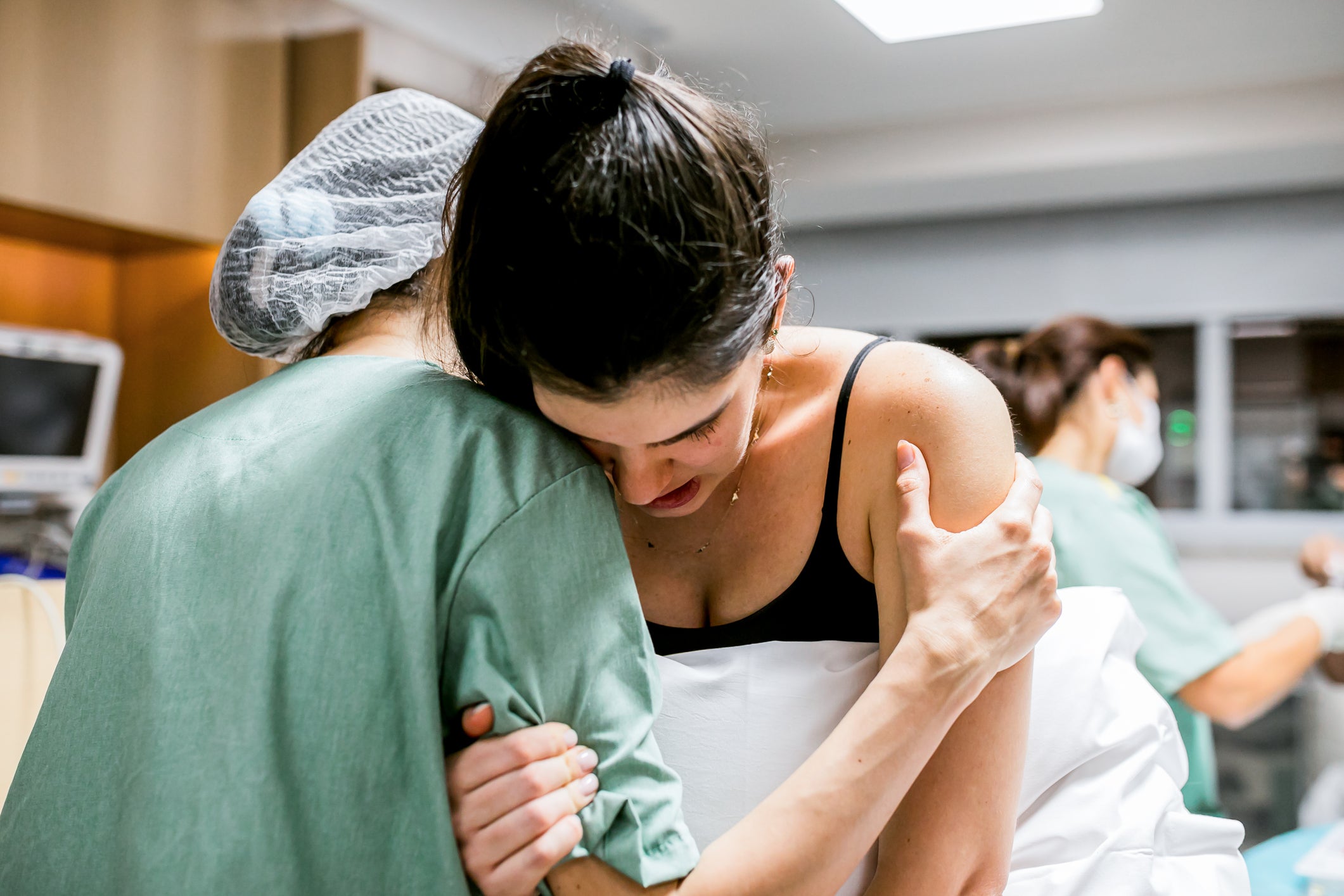
When Sophie Dicks went into labour a few days before a scheduled caesarean in November 2023, she prepared herself for the natural birth she had been hoping for. Having had a C-section for her first baby she had been hoping to give birth naturally, but had been advised to book in for a C-section for 42 weeks when she went past her due date.
Over the following three exhausting days of labour she saw “too many midwives to count” but estimates that it was at least 10. She was then told – without examination – that her labour wasn’t progressing because her contractions weren’t getting closer together. To avoid the risk of infection, a C-section was recommended after all.
“But I was made to wait six hours, while still in labour,” says Dicks. "And when I went in for the procedure, they couldn’t get Remi out. I wasn’t told anything, but suddenly an alarm sounded, 10 people came running in and lifted me upside down so my legs were in the air. He was born and rushed away, but I was in a mess; I’d lost 3.5 litres of blood.
“The problem was that Remi was so far down my pelvis, ready to be born, that they were struggling to perform the C-section without killing me. The surgeon later told me they didn’t know I was in labour when I went in for the procedure. That blew my mind and rang serious alarm bells.”
Dicks’s experience is borne out by the initial findings of the national maternity and neonatal investigation (NMNI) led by Baroness Valerie Amos, which found maternal care in the NHS severely lacking. Amos found that “time and time again” women were not listened to. Among other things, women were left to “bleed out” in bathrooms, with babies suffering avoidable deaths in NHS maternity units. After visiting seven trusts, talking with families and meeting NHS staff, Amos found that changes within maternity care have been “too slow” despite being necessary and urgent.


The report shows that the NHS has recorded a “staggering” 748 recommendations relating to maternity and neonatal care in the past decade.
“Nothing prepared me for the scale of unacceptable care that women and families have received, and continue to receive, the tragic consequences for their babies, and the impact on their mental, physical and emotional wellbeing,” Amos said.
The hospital where Dicks had her C-section later admitted to other mistakes. “Apparently, if a child isn’t born within nine minutes in a C-section, an alarm should sound,” she says. “But they didn’t do that. Instead, they used a phone to ring another phone in the hospital and, luckily, the surgeon walked past the phone at that time. She ran over to deliver Remi straight away, without even having a chance to put gloves on. Had she not walked past that phone, both of us would be dead. We were lucky.”
Still, the experience has left a lasting legacy for Dicks. She suffered from postnatal depression and struggled to bond with her baby for several months because she felt so disconnected.
Sophie’s is just one experience. But the Amos report highlights a number of issues, which she said she has “heard about consistently”. Perhaps it’s no surprise then that statistics show that Britain has higher maternal and infant mortality rates than many comparable European countries. A 2022 study found the UK had the second-highest maternal death rate (9.6 per 100,000 live births) among eight European countries, much higher than, for example, Norway (2.7) and Denmark (3.4).
Britain also ranks poorly on stillbirths and infant deaths: the UK’s infant mortality rate (4.0 per 1,000 live births in 2021) ranked 29th out of 38 OECD countries and is about double that of Nordic countries and Japan. It is also higher than Spain’s (2.5) and Italy’s (2.3).
The problems highlighted in the Amos report are part of a systemic pattern documented across numerous reports and inquiries over the last decade, including the Ockenden Review in 2022, which found repeated failures over two decades, contributing to numerous baby and mother deaths in Shrewsbury and Telford, and issued urgent actions for all trusts. The Birth Trauma Inquiry Report in May 2024 called for an overhaul of care, noting that poor treatment is often tolerated. Hundreds of recommendations for improvement are still awaiting full implementation.
Jo Cruse, founder of Delivering Better, said, “Mothers are being failed every single day due to poor maternity care and a lack of follow-up support in maternity care. Women have been ignored for decades and this report is just the tip of the iceberg with the true horror of what is happening day to day on maternity wards. Women are being politically gaslit by a government which promises progress, but when it comes to maternity care, fails to deliver. This isn’t about midwives; the blame lies firmly with ministers who are failing to fund and support maternity care adequately.
“The current state of care is an acute expression of the medical misogyny that the Health Secretary himself has said has ‘cast a long shadow over maternity care’. We’re hearing lots of promises, yet £95 million was stripped from maternity care funding this year. Our message for the Government is clear: investment needs to happen now to restore confidence in the NHS and protect future healthcare needs.”
But why is Britain failing when so many other countries – particularly the Nordic countries – are doing so much better?
Anna af Ugglas is chief executive at the International Confederation of Midwives (ICM), which is based in the Netherlands, and has over 33 years of professional experience as a midwife and educator. She says that the significantly lower rates of maternal mortality in the Nordic countries and the Netherlands are closely linked to the central role of the midwife.
“Midwives are highly respected in Nordic countries – they are seen as key for gender equality and access to care and generally regarded as solid, trustworthy, highly qualified professionals,” says Af Ugglas, who is from Sweden. “There is a long tradition of professional and autonomous midwives who are well integrated in the healthcare system. Midwives are enabled to work autonomously with collaboration from a doctor when needed.”

“We don’t have debates about the midwife’s role and there are no fights between midwives and doctors because their roles are extremely clear. There are also clear criteria about when to intervene and when not to.”
Af Ugglas explains that midwives are often the main caregiver from the start of a woman’s reproductive life, starting with contraception. This builds trust and confidence in the midwife from the start. Unless there is a complication during pregnancy – when the midwife refers to a doctor for consultation – it is the midwife who leads the pregnancy, birth and postpartum care.
The other big difference is in continuity of care. Af Ugglas cites research that shows that women who see the same midwife throughout their pregnancy and at the birth are more likely to have a positive birth experience. “The gold standard we aim for in Nordic countries is continuity of care – so as much as possible, women see the same midwife during their pregnancy and at the birth. The WHO (World Health Organization) released a position paper on midwifery models of care last year, leading to initiatives for women to see the same midwife, or groups of midwives, during their pregnancy, birth and after birth,” says Af Ugglas, flagging that ICM has launched a global petition calling on governments to grow, support and invest in the global midwifery workforce, in response to the global shortage of midwives.
“There is lots of evidence, including from the WHO, that women who have continuity of care have better outcomes. We know that is what women want – and it results in fewer interventions and a much better experience for the women.”
Unfortunately, being able to provide continuity of care is a distant dream for most midwives working in the UK. Rebecca* is a midwife in North Yorkshire who has been working for the NHS for 13 years, including in some of the trusts mentioned in the maternity report. She describes running around the wards like a “headless chicken” and going home crying about not being able to provide proper care after understaffed shifts.
“Nobody goes to work to provide poor care,” she says. “Who wants to go to their dream job and come home sobbing, feeling you haven’t been able to provide the care you wanted to – because you can’t split yourself into five different people?
“Clearly, something is going massively wrong. As midwives, we want safer staffing and the ability to do our job properly, and proper resources. It all comes down to money at the end of the day; the bottom line is that the staffing just isn’t there. When you’ve got adequate, appropriate staffing, you have got the time to spend with women.”
It is not just the Nordic countries that are taking better care of women and babies. Japan has one of the world’s lowest infant and neonatal mortality rates due to a highly structured and safe maternity system, and universal healthcare access. There is widespread prenatal and postnatal support including the Health Handbook, a government-issued handbook that tracks health from pregnancy to infancy, promoting consistent care, education, and early problem detection.
Canadian national guidelines support home birth as a safe option for low-risk women where midwifery care is integrated into the health system, with outcomes comparable to hospital births and lower intervention rates. Some Canadian and Australian provinces invest in postnatal home visits, early parenting support, and well-resourced perinatal mental-health teams as well as more birth-centre and home-birth options for low-risk women.
Switzerland also has excellent perinatal survival and neonatal care, high standards of hospital obstetric care and neonatal intensive care units.
Sadly, the outcomes of understaffed wards and midwives who are juggling too many patients can be utterly devastating. Among other things, the Amos report highlights instances of women’s concerns about reduced foetal movement being disregarded, often with fatal outcomes. This was the case for Tom Hender, 42, a structural engineer who lives in the West Midlands with his wife, Ewa, 37, a quality and performance manager.
He describes how, a month before Ewa went into labour with their first baby, she noticed reduced foetal movements before her waters broke at 36 weeks. She was diagnosed with PPROM – preterm prelabour rupture of membranes.

“They tested the baby’s heart rate with CTG monitoring and everything was seen as fine,” says Hender. “We were told that the majority of women in her situation will go into spontaneous labour within 24-48 hours. But after 36 hours, Ewa was still there and hadn’t started labour. She mentioned the baby’s movements were fainter – but she wasn’t given a scan.”
The couple asked about options and risks, and they were told the only risk to the baby was infection because the waters had broken. Ewa was prescribed antibiotics and they were sent home to wait for labour to start.
The best places in the world to give birth*
“It is important to note that these indicators alone do not capture the full picture of quality of care or women’s experiences during birth,” says Anna af Ugglas. “These figures do not reflect other critical aspects of care, such as continuity of care, respectful and woman-centred care, equity, women’s experiences during birth or complications and morbidity after birth.”
When it comes to maternal mortality ratio (MMR) the countries with the lowest maternal mortality rates (in ascending order) are:
- New Zealand
- Belarus
- Norway
- Poland
- Australia
- Israel
- United Arab Emirates
- Czech Republic
- Spain
Looking at neonatal mortality, the countries with the lowest neonatal mortality rates (in ascending order) are:
- San Marino
- Japan
- Belarus
- Estonia
- Singapore
- Montenegro
- Norway
- Czech Republic
- Slovenia
- Iceland
*based on the maternal mortality ratio (MMR), according to WHO/UN data
“Three days after her waters broke,” says Hender, “Eva started to get widely spaced contractions throughout the day. In the evening, Ewa passed what we believed was the mucus plug. We called the hospital, but the midwife told us to call back when the contractions were closer together. We believe she wasn’t aware that Ewa was PPROM.
“It wasn’t until 11.45pm that her contractions were closer together, so we drove 20 minutes to the hospital. Halfway there, Ewa told me she was bleeding. I raced to hospital, but there was a delay getting in because nobody answered the buzzer. We were told to wait in the waiting room.
“When we finally saw a midwife, she couldn’t find a heartbeat. She came back with a scanning machine and there was no movement. We could see Aubrey’s ribs, but no movement and no heartbeat. It was just devastating. We were moved into a room in the delivery suite, and she delivered Aubrey at 1.29pm the next day.”
The couple have gone on to have two children; daughter Tallulah and son Indigo. But the grief of baby loss doesn’t go away. “We both have PTSD and have required counselling,” says Hender. “It’s fundamentally changed who we are, our relationship, and us as a family.”
Hender believes that if they had had a scan at any point before Aubrey actually died, which they think should have been indicated by a couple of factors, or if they had had informed discussions about the risks, then he would have been born alive. “We asked questions about risks and weren’t told of an increased risk of stillbirth or cord prolapse. Any opportunity to advocate for an earlier delivery was denied to us.”
They are now taking legal action. “I think there are people that didn’t do their job. I believe that extends to the wider hospital system. The system is broken and needs systemic overhaul and a public inquiry. What’s happening at the moment isn’t going to touch the sides. Something needs to change so that what happened to Aubrey doesn’t happen again.”
Join our commenting forum
Join thought-provoking conversations, follow other Independent readers and see their replies
Comments
Bookmark popover
Removed from bookmarks