It would now be wise to assume China’s Xi is going to move against Taiwan – this is how it will happen
Flanked by Vladimir Putin and Kim Jong Un, Xi’s statement that China is now ‘unstoppable’ was a gauntlet thrown down to the West. This wasn’t just a display of pride, but of intention – Taiwan is already under attack without a boot on the ground, says Michael Sheridan


Make no mistake, Wednesday’s “victory” parade in Beijing was the most significant event since Xi Jinping came to power in China in 2013. It was both a triumph and a prelude; the triumph of military might and the prelude to using it.
The Chinese leader did not don a uniform. Instead, he favoured a plain Mao-style outfit (of distinctive martial cut), in contrast to most of his suited guests overlooking Tiananmen Square.
This was the new China at its most militant. Nuclear missiles, drones, advanced weapons of all kinds, thousands of regimented troops marching in tight precision. Much has been written about it as a display of pride. It is now time to consider intention.
The honoured guests were the Russian president Vladimir Putin and the North Korean dictator Kim Jong Un. With Xi, they made a trio of autocrats, unmistakably identified as the key players of the day by the Chinese media.
All three are hardened survivors. Two of them, Putin and Kim, are steeped in blood. In the Chinese system, there is no longer any need to eliminate opponents physically. But Xi did not hesitate to decimate the military, purging defence ministers, generals and staff officers. The dismissal of his foreign minister in a spy scandal seemed a mere afterthought by contrast.


One wonders whether, over their cups of tea, the Chinese and Russian leaders exchanged ideas about the necessity of purges. For Putin, the spectre of Yevgeny Prigozhin, rebel leader of the Wagner Group, who died in a mid-air explosion, has vanished from his calculations.
As for the ever-smiling Kim Jong Un, he lives with the knowledge that he executed his own uncle, Jang Song Thaek, after a reported tip-off from China that Jang was plotting against him. Kim’s unfortunate relative was tied to a scaffold in front of an audience of cadres and shredded by an anti-aircraft gun.
Nothing in Xi’s biography suggests that he enjoys cruelty or is personally ruthless. But he does wield power in a way that rivals Stalin in purpose. It would now be wise to assume that he is, in fact, going to move against Taiwan.
US intelligence and military officials have testified that Xi has instructed the People’s Liberation Army (PLA) to be ready to “invade or coerce” Taiwan by 2027 – a date marking the centenary of the PLA’s founding. The date is not very far away. It must be taken seriously, because the autocrats may think there may never be a better time in world politics to strike.
Xi and his comrades have watched as Putin’s war in Ukraine turned from blitzkrieg to stalemate. But there is no higher consideration in the Chinese system than survival. China considers that Putin has won the war merely by avoiding defeat.
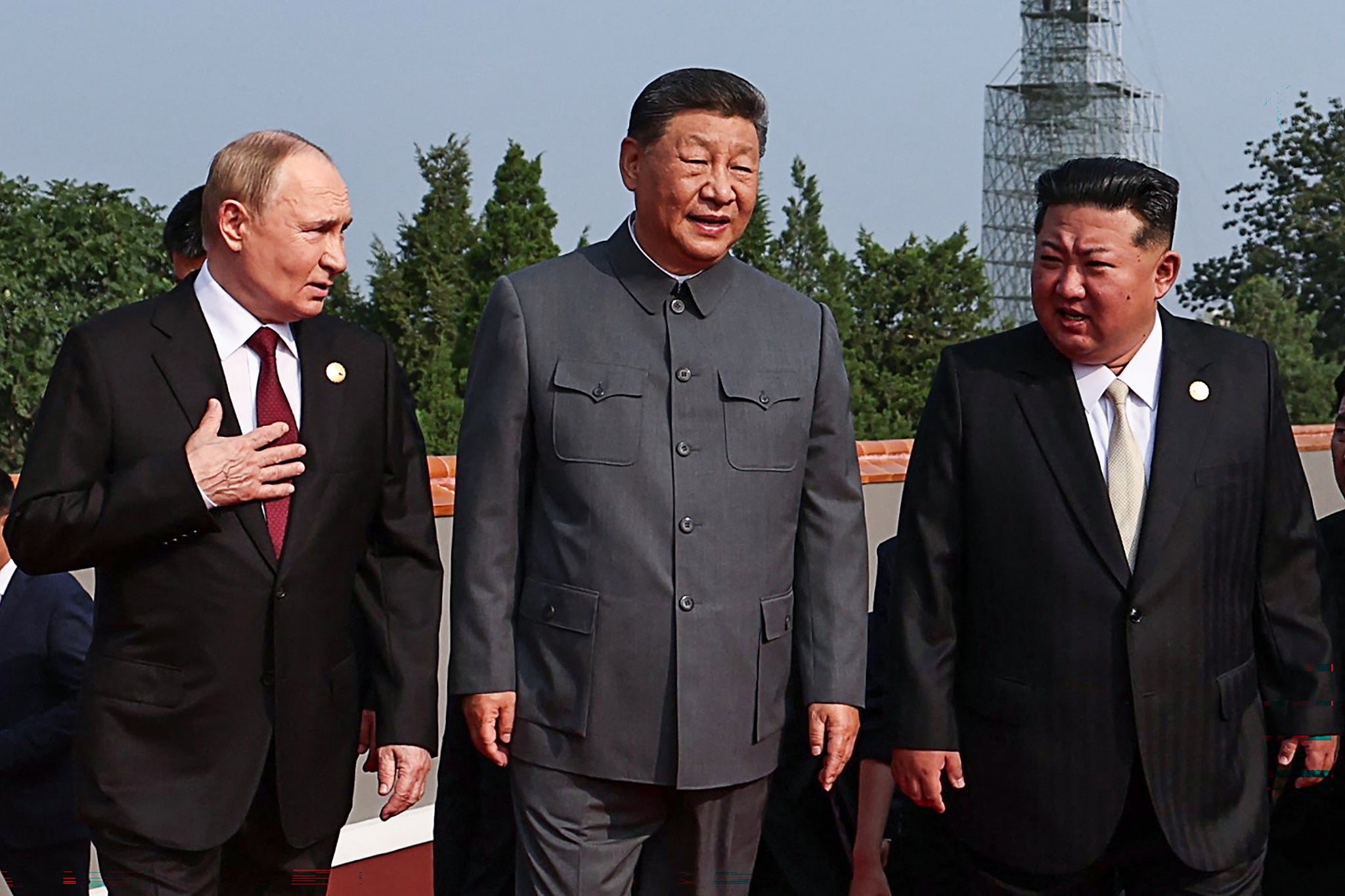
The third of the trio, Kim, is a veteran of three summits with US president Donald Trump, from which he emerged with both his nuclear arsenal and his power intact. If ever a group of leaders radiated confidence, it is these three.
For all their belligerence, Putin and Kim do not have military credentials; Kim is a nepo baby and Putin a civilian KGB operative. Xi does. His father was a commander under Chairman Mao who fought campaigns across northern China in the country’s civil war.
Xi’s first job was in uniform as one of three private secretaries to the defence supremo of China. At a young age, he was privy to military secrets. This was a staff post, of course, for no Chinese general has fought a land campaign since 1979.
But throughout his rise up the civilian ranks of the party, Xi took care of the soldiers. While governing on the east coast, facing Taiwan, the record shows that he spent time visiting garrisons, improving conditions for the men, making sure families had good accommodation and boosting morale.
Now he reaps the rewards. Insecure emperors do not parade themselves in front of thousands of armed troops. I doubt that he has ever looked so solid in office.
So where does it go from here? China has absorbed multiple lessons from Russia. It has learned, for one thing, that it does not have to storm the beaches of Taiwan.
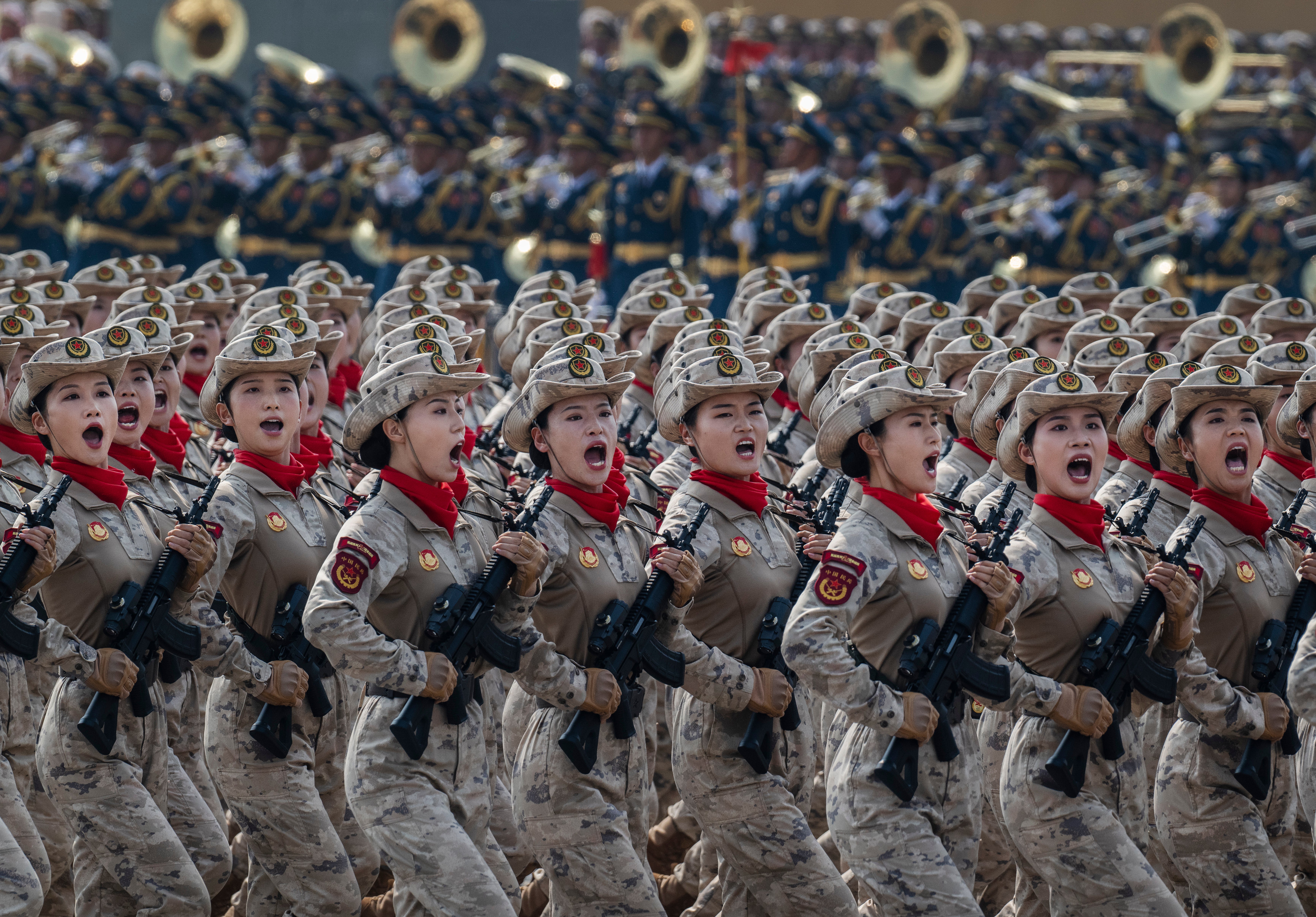
“A combined operation involving an opposed landing [is] one of the most difficult and hazardous operations of war,” as Winston Churchill wrote. Xi knows the quote: his father had read Churchill’s memoir. Putin has shown him that he does not have to do it that way.
Chinese tactics against Taiwan could be a hybrid of the Crimea and the dash to Kiev. Perhaps Putin has studied the German strategist Carl von Clausewitz and his theory of the concentration of maximum force at a decisive point. Xi and his generals know it by heart.
In this scenario, China could command the seas by defeating an American force with one kinetic shock, securing control of the strait between Taiwan and the mainland. It could proclaim blockades, maritime quarantines, compulsory shipping lanes and aviation exclusion zones. Its new weapons could shatter American and Allied air and naval supremacy.
Then there is what Mao called the “magic weapon” of propaganda and appeals to the greater Chinese nation. There is a ceaseless campaign of infiltration and cyberwar to persuade the Taiwanese that resistance is futile and destiny beckons and unity is inevitable. Chinese state outlets push narratives that the US cannot be trusted to defend Taiwan, emphasising the economic benefits of closer ties with Beijing. As Xi said at the parade, China is “unstoppable”.

The trio of autocrats see this as part of a new world order to replace the old world made after 1945. They explicitly used the victory parade to state an “authentic history” of the time and to promote, of all things, the United Nations as their instrument of change.
The Chinese foreign ministry unveiled three faults in the UN, first, “serious underrepresentation of the global South”, second, “erosion of authoritativeness” and, third, an “urgent need for greater effectiveness”. All bland, who could possibly object?
Then it added: “Governance gaps exist in new frontiers such as artificial intelligence, cyberspace and outer space.” The solution: “China proposes the Global Governance Initiative (GGI) to promote the building of a more just and equitable global governance system and work together for a community with a shared future for humanity.”
Naturally, it promised “extensive consultation and joint contribution” suitable for China’s role as “a staunch builder of world peace, contributor to global development, (and) defender of the international order”.
Xi Jinping, Vladimir Putin and Kim Jong Un may not seem the likeliest people to run a consultation exercise to make the world a kinder place through AI and space travel. “Global governance” on their terms is an offer that nobody is meant to refuse. The gauntlet has been thrown down.
Michael Sheridan is author of ‘The Red Emperor: Xi Jinping and his New China’, out now in paperback from Headline Press at £12.99
Join our commenting forum
Join thought-provoking conversations, follow other Independent readers and see their replies
Comments
Bookmark popover
Removed from bookmarks