China allowed couples to get married anywhere they want. The results are huge
China saw a 20% decline in marriages last year
In a nationwide effort to increase marriage rates, China began allowing couples to get married anywhere in the country last May, rather than at their place of residence.
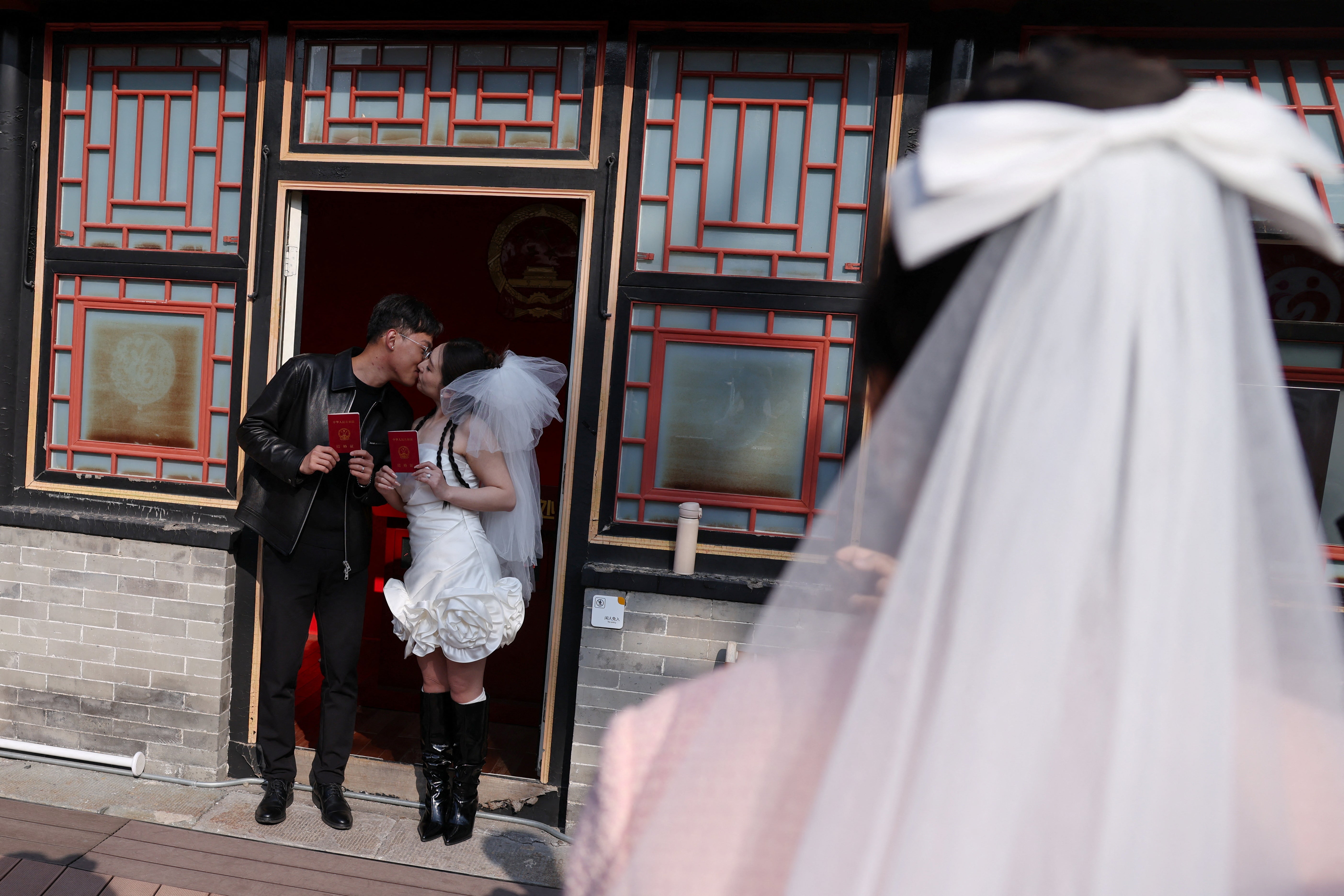
Local governments have since seized the opportunity to create marriage tourism destinations, setting up registration offices in scenic spots, at music festivals, and even in subway stations, shopping malls, and parks.
For now, the effort is working.
China’s marriage rates rise
Marriages, which demographers use as a proxy for the country's birth rate, rose 22.5% from a year earlier to 1.61 million in the third quarter of 2025, putting China on track to halt a downtrend in annual nuptials, which has gone almost uninterrupted for more than a decade.
Last year's 20.5% decline in marriages, to 6.1 million, was the biggest on record.
In the eastern city of Nanjing, couples can get married at the Confucius Temple, where they can have a Ming Dynasty-themed ceremony. In southwestern Chengdu, authorities set up an office on the picturesque Xiling Snow Mountain at an altitude above 3,000 metres (9,842 feet). In eastern Hefei, a marriage booth opened in a subway station whose name, Xingfuba, translates to "the place of happiness."
And in Shanghai, couples can choose to get their certificate at a nightclub after appearing at a marriage registration office, thanks to a partnership between INS Park, a six-storey nightlife complex, and the Huangpu District Civil Affairs Bureau.
In Beijing, 31-year-old lawyer Wang Jieyi and 33-year-old Zhan Yongqiang, a bank employee, registered their marriage at the Huguo Guanyin Temple.
"The Huguo Guanyin Temple was originally built to safeguard the peace and tranquility of the nation," Wang said. "And also, in our traditional religious culture, the Guanyin Temple is associated with auspicious events like marriage and giving birth, symbolising happiness and well-being."

The couple said the new policy didn't necessarily fast-track their plans to get married but it made the process more convenient as they both work in Beijing and no longer need to go back to their native Shandong province.
"It made our lives a little bit easier," said Wang.
It’s a numbers game
Tourists go to Xinjiang's Sayram Lake, where bank clerk Ren Yingxiao got married, for the steep mountains and quiet pastures surrounding it. But it's the lake's geographical statistics that convince couples to marry there.
It stands 2,073 metres above sea level, a number that sounds like "love you deeply" in Chinese. It has a surface area of 1,314 square kilometres and that figure is phonetically similar to "a lifetime." Xinjiang's capital, Urumqi, is 520 kilometres away - homophonous with "I love you."
"All those numbers had symbolic meaning," said Ren.
Demographer Yi Fuxian from the University of Wisconsin-Madison said the removal of geographic restrictions is making weddings easier in China, but expects the positive results to be "short-lived."
With the population declining, Yi expects the number of women aged 20 to 34 to nearly halve to 58 million by 2050. Moreover, he expects young women - and their parents - to give greater priority to education and economic independence over marriage, in line with global trends.
Ren concurred, saying she would have gotten married anyway. She believes marriage and birth rates will improve only when incomes start growing and people feel more financially secure.
“It's unlikely that two people who didn't plan to get married would suddenly decide to do it on impulse while travelling," she said. "That’s not very realistic."
Join our commenting forum
Join thought-provoking conversations, follow other Independent readers and see their replies
Comments
Bookmark popover
Removed from bookmarks