Nighttime economy drawing in eager consumers
THE ARTICLES ON THESE PAGES ARE PRODUCED BY CHINA DAILY, WHICH TAKES SOLE RESPONSIBILITY FOR THE CONTENTS


Nighttime dining, shopping and travel are thriving across China this summer, injecting fresh momentum to economic growth.
The market size of China’s nighttime economy has so far surpassed 50 trillion yuan (£5.2 trillion), said marketing consultancy Zhiyanzhan.
More restaurants have extended business hours and launched delivery services to attract late-night diners and increase revenue.
Huda Restaurant, a popular crayfish eatery in Beijing’s bustling Guijie Street, is operating four outlets in the same area, cumulatively serving more than 6,500 customers daily on average. During peak hours on some nights, customers sometimes have to wait in line for three hours, according to the restaurant.
“Tourists are often unable to wait that long to dine in. Some choose the takeaway option, or order deliveries to their hotels. Some 70 per cent of our takeaway orders come from nearby hotels, as many tourists tend to order deliveries at night after their daytime sightseeing in the city,” said Zhang Shengtao, deputy general manager of Huda.
“We take food delivery platforms as an important supplement to our operations, as the platforms allow customers to search for our restaurant from different channels. With no increase in the number of staff members and no change in restaurant areas, delivery services can help raise order volumes and lead to profit growth,” Zhang said.
The restaurant chain said diners aged between 25 and 39 account for a large share of its total customers, while consumers opting for deliveries are mainly aged between 18 and 35.
Hong Yong, an associate research fellow at the Chinese Academy of International Trade and Economic Cooperation, said the availability of nighttime dining meets the demand for late night snacking among urban white-collar employees and many young consumers, especially as more people stay up late, work overtime, or venture out for social entertainment, and late night dining gradually becomes a part of their daily routine.
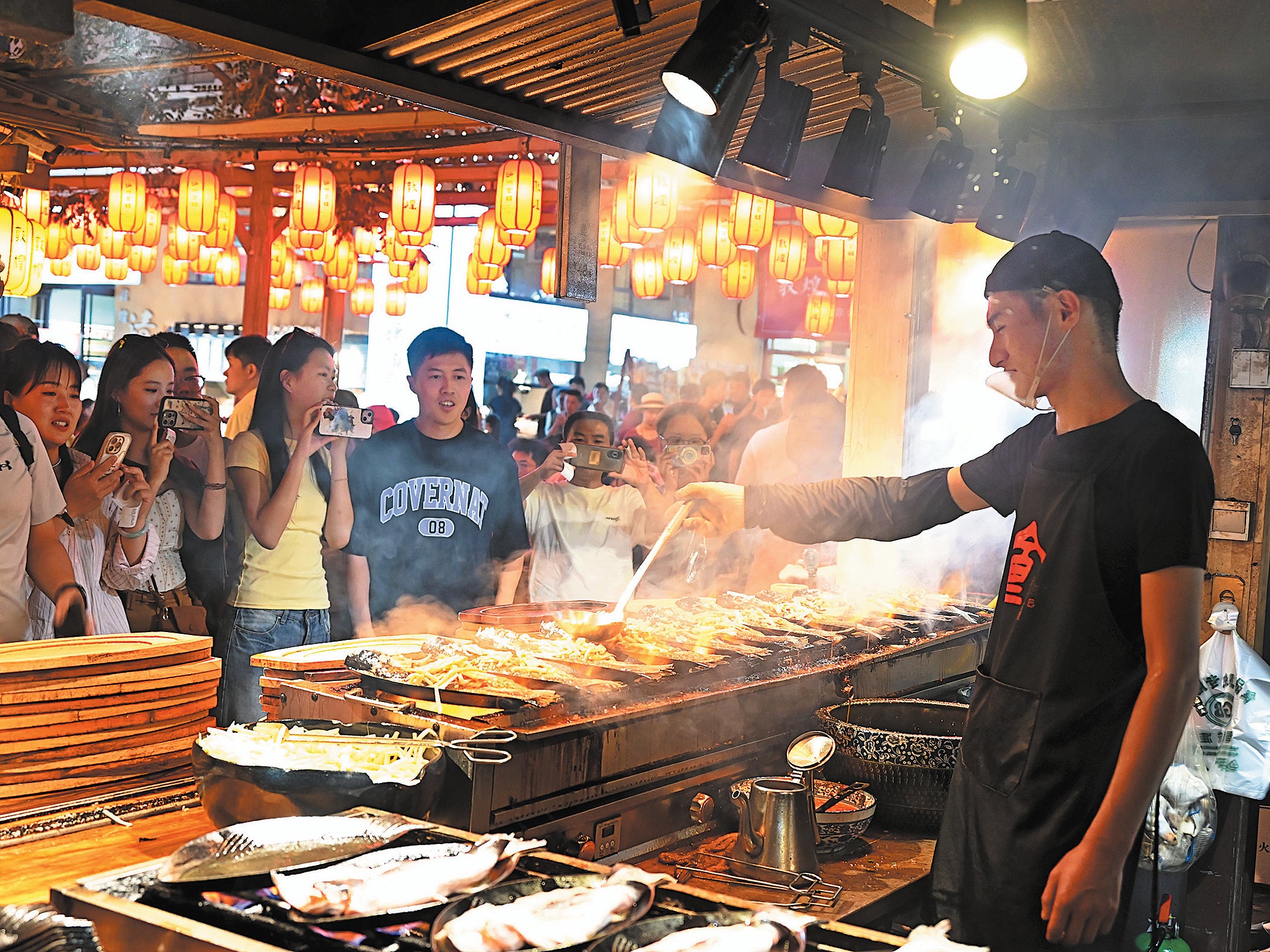
“Nighttime economic activities such as dining, night tours and shopping provide richer consumption scenarios, and meet consumers’ demand for leisure and entertainment, social interaction and emotional release,” Hong said.
“The expansion of nighttime consumption scenarios will help promote the diversification of consumption formats, encourage higher frequencies of spending, effectively stimulate domestic demand and promote sustained economic growth momentum.”
According to a report released by the Ministry of Commerce, 60 per cent of China’s urban consumption takes place after dusk. At large-scale malls, sales between 6 pm and 10 pm usually account for over half of the whole day’s revenue.
In addition to the catering sector, many sightseeing spots have extended their opening hours this summer, and upgraded night tourism products to meet the diverse demand of travellers. Besides driving an increase in ticket revenue for scenic spots, it has promoted the growth of related businesses such as catering, accommodation and shopping in surrounding areas.
In Guiyang, Southwest China’s Guizhou province, a three-day international kite festival that included nighttime events attracted more than 163,000 tourists in July, netting tourism revenue of over 60 million yuan, according to the local government.
Night markets, roadside concerts in parks, trunk markets and other nighttime consumption scenes were attractive to tourists.
“This type of nighttime cultural tourism model, with feature activities as its core, gathers popularity and forms a consumption loop, and has become an effective way to boost the nighttime economy,” said Mu Qianyi, an analyst of LeadLeo Research Institute, a market research provider based in Shanghai.
Mu added that new technologies and scenarios such as drone light shows at night will help enrich the experiences of tourists. The improvement in the quality of scenes naturally enhances the attractiveness and vitality of nighttime cultural tourism, and could help inject new impetus into economic growth.
Bookmark popover
Removed from bookmarks