Are you dead? The morbid app taking China by storm
App offers sense of security to millions of people living alone across the country
A morbidly named mobile app has climbed to the top of Apple store’s paid charts in China, offering a stark reminder of how bleak modern life can feel for both young and old alike.
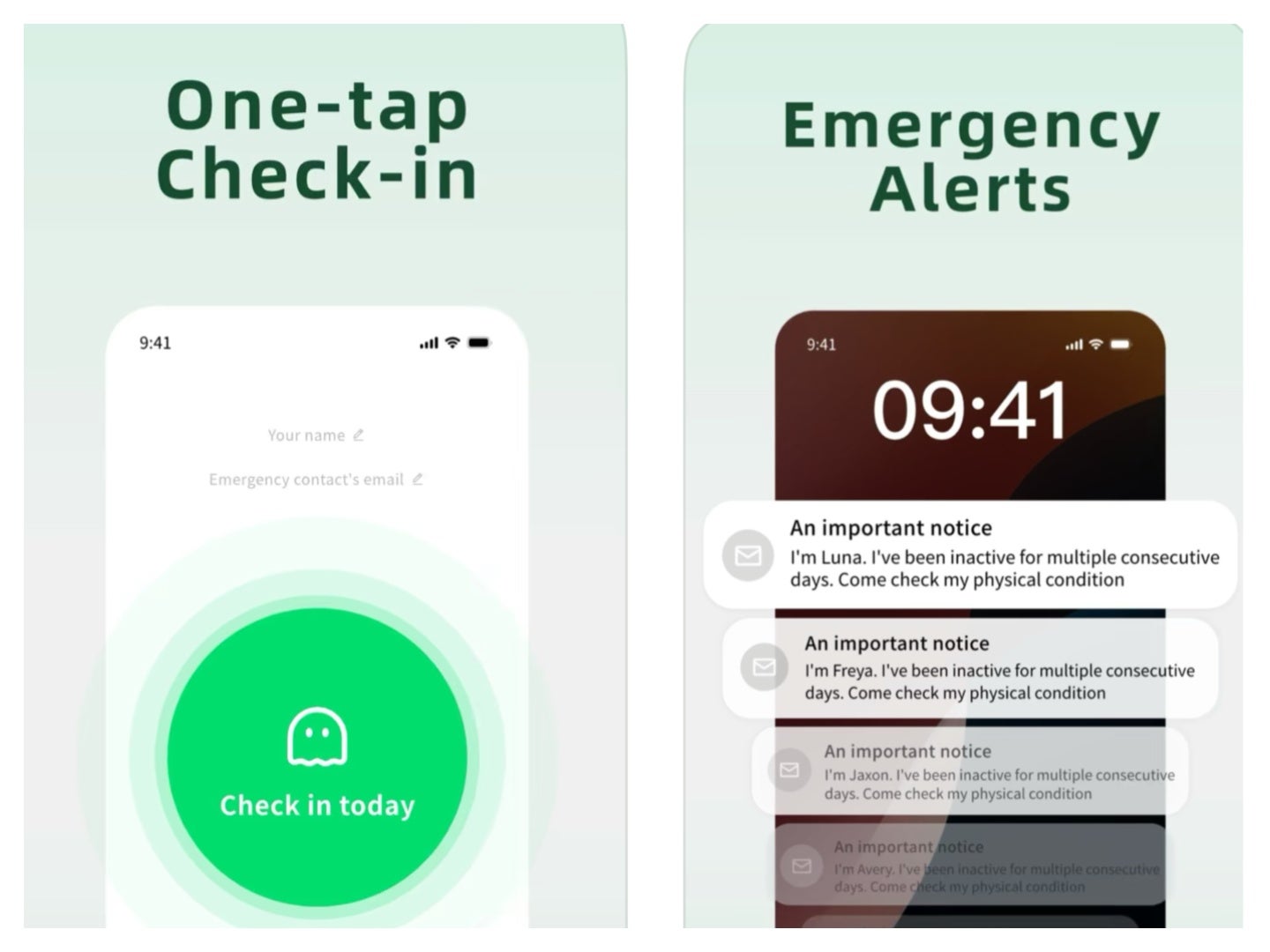
The Are You Dead? app, called Sile Me in Chinese, asks users to check in daily by tapping a bright green button with a cartoon ghost at the centre. If a user fails to check in for two consecutive days, the system automatically sends an email to the emergency contact selected by the user.
Although Sile Me was launched last year as a free app, it slowly made its way into the paid category and climbed the charts to become the top paid app in China in the first week of January. For 8 yuan ($1.15, £0.85), the app provides a sense of security to millions of people living alone across the country.
Sile Me, listed internationally as Demumu, has also surged into the top two paid utility apps in the US, Singapore and Hong Kong, largely driven by Chinese immigrants there.
On the Apple store, the app is described as a "lightweight safety tool" made for people living alone to "establish invisible safety protection through check-in monitoring and emergency contact mechanisms to make solitary life more reassuring".
Living alone in China can be deeply isolating, fuelling anxieties about dying unnoticed. The country is projected to have as many as 200 million one-person households by 2030.
An increasing number of young Chinese are choosing to live alone rather than get married, while a growing number of elderly people are being left isolated in their homes without relatives nearby to care for them.
China recorded its third consecutive year of population decline in 2024, a year after ceding the title of the world's most populous country to India. China’s birthrate has been declining for decades, driven by the “one-child policy” implemented from 1980 to 2015, along with rapid urbanisation.
The Asian giant officially ended its “one-child policy” in 2016, but not before it had resulted in a skewed population due to a cultural preference for male children.
The high cost of childcare, education, job uncertainty, and a slowing economy have discouraged many young Chinese from marrying and starting families, demographers say. They also point to gender discrimination and traditional expectations for women to manage the household as contributing factors to the declining birthrate.
Single-person households accounted for 19.5 per cent of all homes in China in 2024, up from just 7.8 per cent two decades earlier, according to the National Bureau of Statistics.
The anxieties around solitary life are also often triggered by the fact that the country spends just 6 per cent of its GDP on welfare accounts, much lower compared to other emerging economies.
The app’s developers described themselves as a small, independent startup of three co‑founders born after 1995, and expressed their appreciation towards the users. "We feel honoured and deeply grateful to receive such widespread attention," the team said in a statement, according to Global Times.
The app's viral surge began only in recent days, the team said, triggering a more than 100-fold spike in downloads that drove up server load and operating costs, the National Business Daily reported.
One of the members, who goes by the name Mr Guo, told local media that the app was built for a little over 1,000 yuan (£106), but they now intended to sell 10 per cent of the company to raise 1m yuan (£10,600).
Another member of the founding trio, who identified himself only as Mr Lyu, said the app’s target users were young people living alone in the biggest cities, especially young women around the age of 25.
These people were likely to “experience a strong sense of loneliness due to the lack of people to communicate with ... accompanied by ... worries about unforeseen events occurring without anyone knowing”, he said, according to the Financial Times.
Although the app was widely praised on Chinese social media platforms, it also drew criticism for its ominous use of the Chinese word for death in its name. A user surnamed Zhao from Sichuan in southwest China said he would pay to download the app if it were renamed "Are You Alive".
The Sile Me team said they planned to roll out new features, including messaging tools and more elderly-friendly functions, and were also considering renaming the app.
Join our commenting forum
Join thought-provoking conversations, follow other Independent readers and see their replies
Comments
Bookmark popover
Removed from bookmarks