The Playboy of the Western World review, National Theatre – Nicola Coughlan leads a gorgeous but uneven production
JM Synge’s 1907 Irish tragicomedy captures a community’s ravening hunger for something new
-and-Nicola-Coughlan-(Pegeen-Mike)-in-The-Playboy-of-the-Western-Worl.jpg)
Two of Ireland’s best-loved comic actors go head to head in this moody staging of a neglected 1907 farce. Nicola Coughlan (Bridgerton, Derry Girls) and Siobhán McSweeney (Derry Girls) are armoured in corsets and many-layered skirts, fighting over the same man – the title’s Playboy. But he’s no prize. He’s more like a limp, soggy chip that all the birds are inexplicably squabbling over. JM Synge’s landmark Irish tragicomedy is a singular exploration of mass hysteria, female sexuality and mob rule. It’s also densely written and deeply strange, meaning it’s not a straightforward watch – but its leads have got enough vigour and wit to carry us through.
Coughlan plays it straight as naive but excitement-hungry barmaid Pegeen, who’s captivated by a bedraggled Christy (Éanna Hardwicke) after he stumbles into her pub claiming to have murdered his father. Then her conniving rival, Widow Quin, swoops in to make a play for this gawky interloper: McSweeney is wonderfully funny as this calculating local weirdo, willing to trade her happiness for business advantage. She’s suckled a black lamb at her breast, then served it up in a pot roast, we’re told, in one of the many strikingly dark images that Synge’s play is filled with. Soon, Christy is becoming an unlikely local hero, but it’s clear that this rough town will soon shoot him down from his pedestal.
After all, this gorgeously designed play is bookended with the spine-chilling wails of mourning women, their black veils set against driving rain. Artistic director of Dublin’s Abbey Theatre Caitríona McLaughlin has decided to lean into this story’s richness and oddness by framing it with scenes from Irish village life at its very creepiest. Traditional mummers in conical straw masks cavort across the stage, while Adrienne Quartly’s soundtrack underscores the action with ominous sounds that channel gothic Irish folk rockers Lankum. It’s a reminder that Synge’s humour is from an era and culture where life was more brutal – modern audiences probably won’t be in stitches at the sight of an old man being beaten about the head with a potato farming implement.

-and-Company--Photo-by-Johan.jpg?quality=75&width=230&crop=3%3A2%2Csmart&auto=webp)
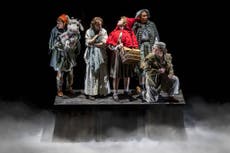
Still, McLaughlin doesn’t really do enough to make this undeniably powerful (and on-trend) aesthetic speak to this play. Instead, the tone feels disconcertingly uneven. Some bleak scenes are played straightforwardly for laughs, while potentially comedic moments (the final punchline included) are invested with a surprising heaviness.
It’s also hard to follow the allusive, complex text here if you’re not used to it. Of course, it would be totally wrong to anglicise or simplify Synge’s language, given that he was part of a renaissance of Irish linguistic pride and identity. But some of the performances here do seem to emphasise character over clarity, especially when seen from a distance in this huge theatre – the early scenes feel like you've crashed into a County Mayo pub midway through a conversation you’ve no hope of catching up on.
What does come across powerfully is the sense of this isolated, impoverished community’s ravening hunger for something new – something better. The play’s women become a frenzied Greek chorus, feeding on the promise of Christy’s attention. One even licks his boots, expertly identifying the taste of each Irish county he’s trudged through like she’s a soil sommelier. There’s an authentic, rare flavour to this story, too – but it’ll take an experienced palate to fully appreciate it.
On at the National Theatre until 28 February
Join our commenting forum
Join thought-provoking conversations, follow other Independent readers and see their replies
Comments
Bookmark popover
Removed from bookmarks