Turner & Constable, Tate review – An epic confrontation between the ultimate British artists
Must-see exhibition juxtaposes the artists’ competing, yet closely related internal worlds in an unexpected, thrilling manner
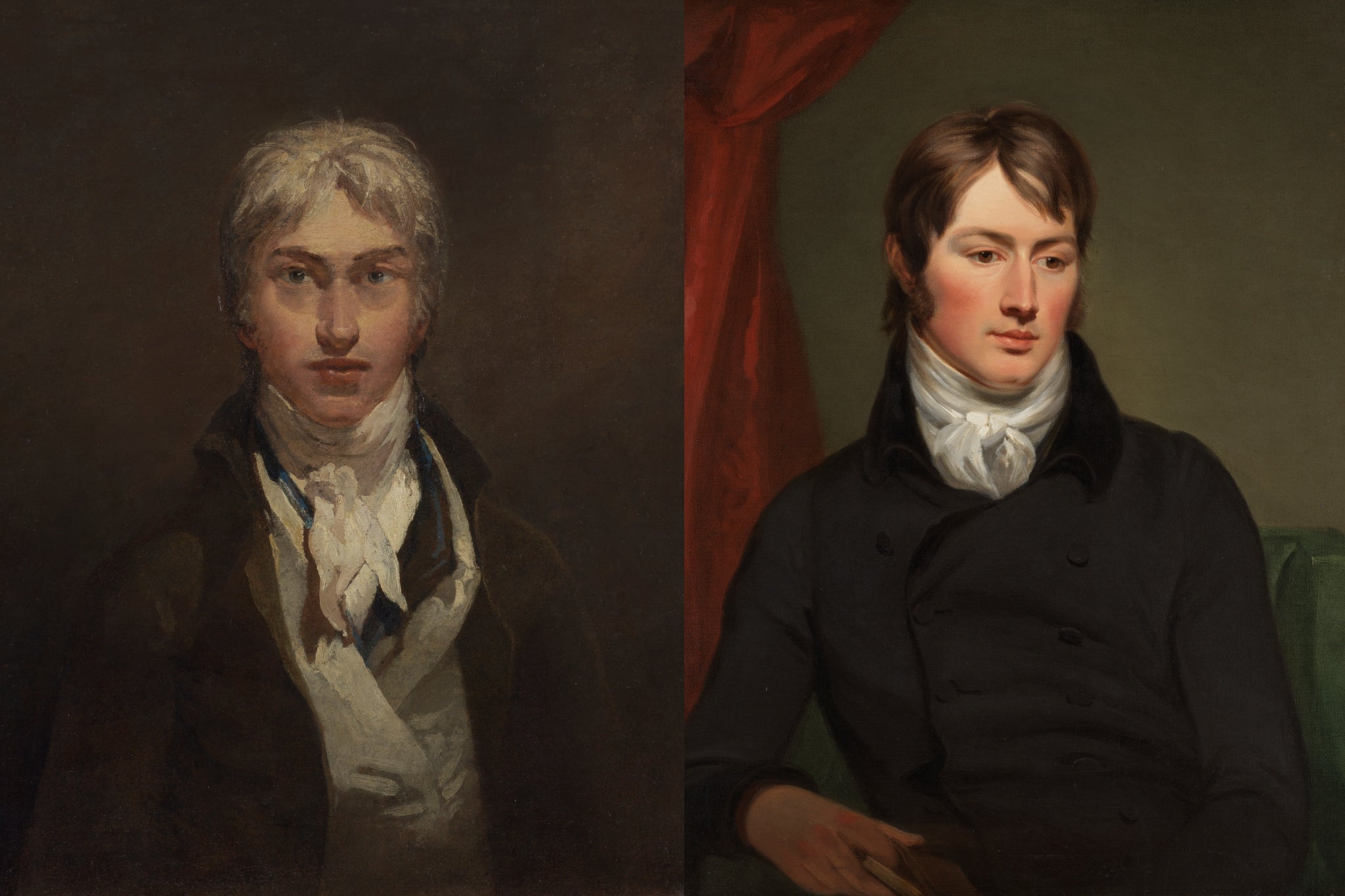
“Fire and water… The one all heat, the other all humidity – who will deny that they each exhibit, each in his own way, some of the highest qualities of art?” So wrote a contemporary in 1831 of the two then giants of British art, JMW Turner and John Constable, with the clear implication that he was struggling to decide which was the greater.
I know how he felt, having been asked to comment on that very subject in 2018, when Constable’s Salisbury Cathedral from the Meadows and Turner’s Caligula’s Palace and Bridge – the paintings that almost brought them to blows at the Royal Academy in 1831 – were touring Britain. I fudged the issue, on the feeble grounds that since each of these giants was so “brilliant in his own area”, it was impossible, and unnecessary, to favour one over the other.
I’ve kicked myself ever since for not forcing the question on which of them – the mercurial and patently radical Turner or Constable, who reveals his passion more slowly – has had the greatest impact, not just on painting, but our very perception of reality.
.jpeg?quality=75&width=230&crop=3%3A2%2Csmart&auto=webp) William Nicholson: Pallant House Gallery, review – It’s clear the artistic patriarch was far from legend’s dullard
William Nicholson: Pallant House Gallery, review – It’s clear the artistic patriarch was far from legend’s dullard Wright of Derby: From the Shadows, National Gallery review – an exhibition that illuminates the shadows of the enlightenment age
 Peter Doig: House of Music, Serpentine Gallery review – An entrancing show that unites the painter’s two passions: art and music
There’ll be no such compromises with this epic confrontation, celebrating the 250th anniversary of their birth – Turner’s in April this year, Constable’s next June. While it isn’t, of course, billed as a showdown, there are constant references to their personal and posthumous rivalries, with paintings placed in juxtapositions that seem designed to force comparative judgements. Entire rooms are set up to showcase the brilliance of one artist, then the other, with a scrupulously fair division of the exhibition space.
That said, Turner seems to dominate the proceedings from the first room. His large and magnificently atmospheric view of the Tamar Valley, Crossing the Brook (1815), looks slickly international beside Constable’s doggedly local Dedham Vale (1828), showing a tranquil corner of the artist’s beloved east Suffolk. Yet if Turner’s determination to make the Devon-Cornwall border feel like some epic area of southern Europe might feel a shade mannered in a more ordinary artist, his, we’re persuaded, is the larger vision.
A trio of dramatic early land and seascapes place Turner in the vanguard of European Romanticism. The locations are all British: Buttermere Lake, Morning on the Coniston Fells and Fishermen at Sea (probably painted at Margate). Yet their yearning towards the “sublime” – what is awesome and terrifying in nature – in dark mountains and the nocturnal sea, feels truly heroic. Constable responds with a kind of transcendent ordinariness. There’s a brooding, hypnotic quality to the apparently placid Flatford Mill from the Lock (1812), the dark masses of quintessentially English trees reflected in a platinum-toned pond, compelling our attention the moment we enter the room.
From here on, our focus is buffeted every which way by competing evocations and conceptions of the sublime: is wonder to be discovered in remote and romantic locations, or close at hand, in what’s right under our noses?
The overarching black cloud in Turner’s huge early work Snowstorm: Hannibal and his Army crossing the Alps (1812) seems to pull us into the painting as though into some terrifying vortex. Then, through a doorway, we glimpse his Norham Castle Sunrise (1845), showing the late Turner at his most Impressionist, with land, form and the very mind of the viewer dissolving into veils of pure, incandescent colour.
Yet any sense of Constable as a cosy, relatively conventional figure – as he was long regarded – is blown away by his Stoke-by-Land (1835) hanging alongside. Every inch of the “typically English” scene – a church tower, a twisty lane – appears in a state of turbulent agitation. Moving in close, we’re intensely aware of Constable’s brush skidding and spiralling over the canvas. The jittery On the River Stour (1834), right next to it, looks like Cezanne on drugs.
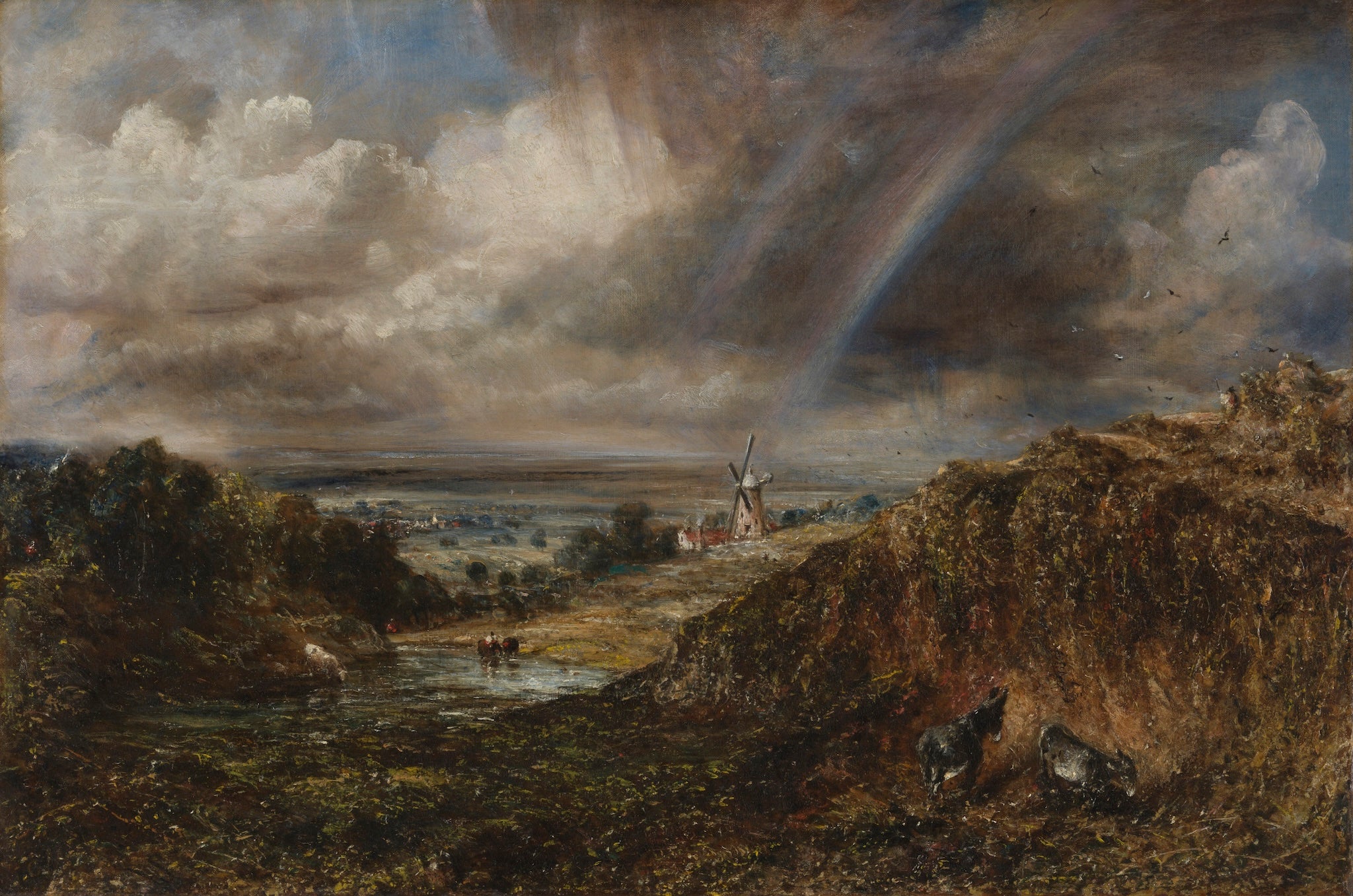
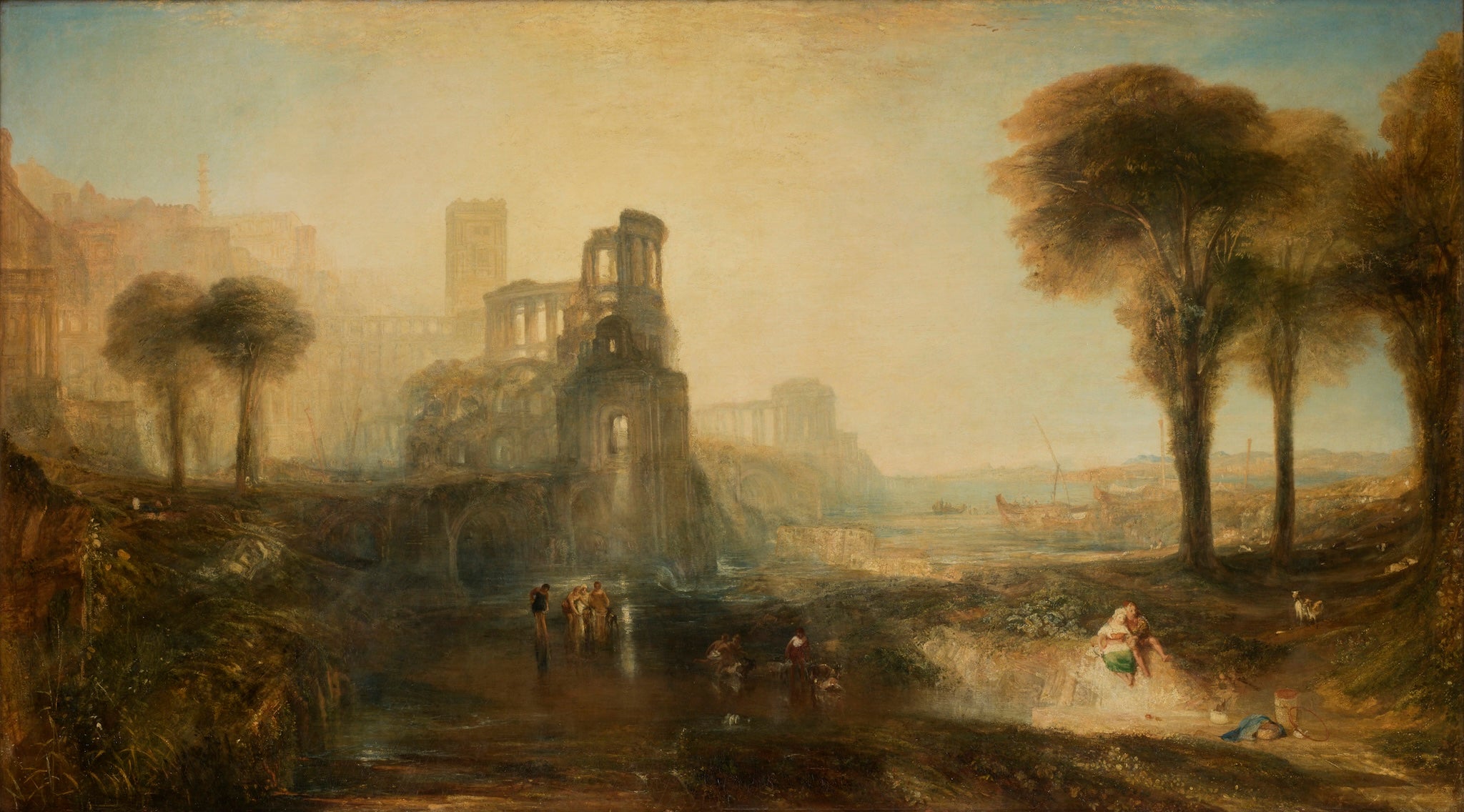
If we’re to frame our comparisons in the terms of that 1831 Royal Academy confrontation, and the paintings are juxtaposed again here, Constable would be the clear winner. Salisbury Cathedral from the Meadows is a great visionary evocation of England, the ancient Gothic spire rising into a stormy sky riven with a mystical rainbow, as a prosaic horse and cart trudge through the foreground. Turner’s Caligula’s Palace and Bridge (both 1831), in contrast, feels like a flashy exercise in what today would be called “special effects”: generic-looking ruins and trees looming out of layers of yellow haze designed to evoke ancient grandeur. It’s a technical tour de force, but you don’t quite feel his heart’s in it. The even larger and more imposing Dido Building Carthage and The Decline of the Carthaginian Empire feel even more calculated to drop the jaws of wealthy collectors.
Meanwhile, Constable’s East Anglian river views, hanging on the opposite wall, disarm through their utter lack of sham or pretence. But then, just as I was coming down in the Dedham lad’s favour, I found myself in a room of Turner’s most personal and visionary late paintings. So, ultimately, for me it’s Turner. He's a broader, more multifaceted artist who takes us into more dimensions we’ve never been to before.
I know what I think, but you’ll want to make your own mind up. Because you absolutely must see this exhibition. Walking through it, I feel completely immersed in these artists’ competing, yet closely related internal worlds. Works from Tate’s own collection are brought together with major paintings from international institutions, in permutations you won’t have seen before, and almost certainly won’t see again. Despite the competing claims of more recent figures, many of them genuinely significant, these guys still are the ultimate British artists.
‘Turner & Constable’ is on at Tate Britain until 12 April 2026; tickets here
Join our commenting forum
Join thought-provoking conversations, follow other Independent readers and see their replies
Comments
Bookmark popover
Removed from bookmarks