The designers trying to help victims of the refugee crisis by building apps and shelters
A new prize competition aims to prove that creative disciplines have a part to play in helping the displaced and dispossessed. Kashmira Gander reports
Whether still in flight from their homes, or awaiting the outcome of their asylum process far from what used to be their homes, some 21.3 million people worldwide are refugees. What, then, can help these people who are dealing with the most desperate situations that life can throw at them: homelessness, hunger, persecution, and physical and mental trauma?
This is a question that Dutch organisation What Design Can Do (WDCD) has posed to creative types across the world, by throwing down the gauntlet in their inaugural Refugee Challenge. A collaboration between WDCD, the UN Refugee Agency (UNHCR) and the Ikea Foundation – the philanthropic arm of the Swedish design giant – some 631 concepts from 70 countries have been entered into the contest and whittled down to a shortlist of 25 by a team of designers and humanitarian experts.
Other than sticking to the challenge’s core principles – creativity, originality, relevance, feasibility, scaleability and impact – there are no rules. The winner, who will be announced today at the What Design Can Do Live event in Amsterdam, will receive €10,000 (£8,200) and expert coaching to help launch their idea.
Sustenance, shelter and sanitation are the most pressing needs faced by refugees, particularly those in transit. But long-term issues – such as education, employment, health, and nutrition – are harder to solve. Nevertheless, Richard van der Laken, founder and creative director of WDCD, is optimistic about change. “As a designer I have always had the feeling that design is often perceived as something nice, exclusive, or aesthetic. But it is more than that. It can help transform society and foster new perspectives,” he says.
The variety of concepts on the shortlist – from functional to conceptual – highlights the mind-boggling complexity of displacement. The Reframe Refugees, for instance, is a photography agency that aims to shift the mainstream narrative of displacement by connecting refugees with media agencies, as 90 per cent of refugees carry a smartphone. It enables refugees to tell their stories on their own terms – a noble concept – but the money paid for photos goes to a refugee charity rather than into the photographer’s pocket.
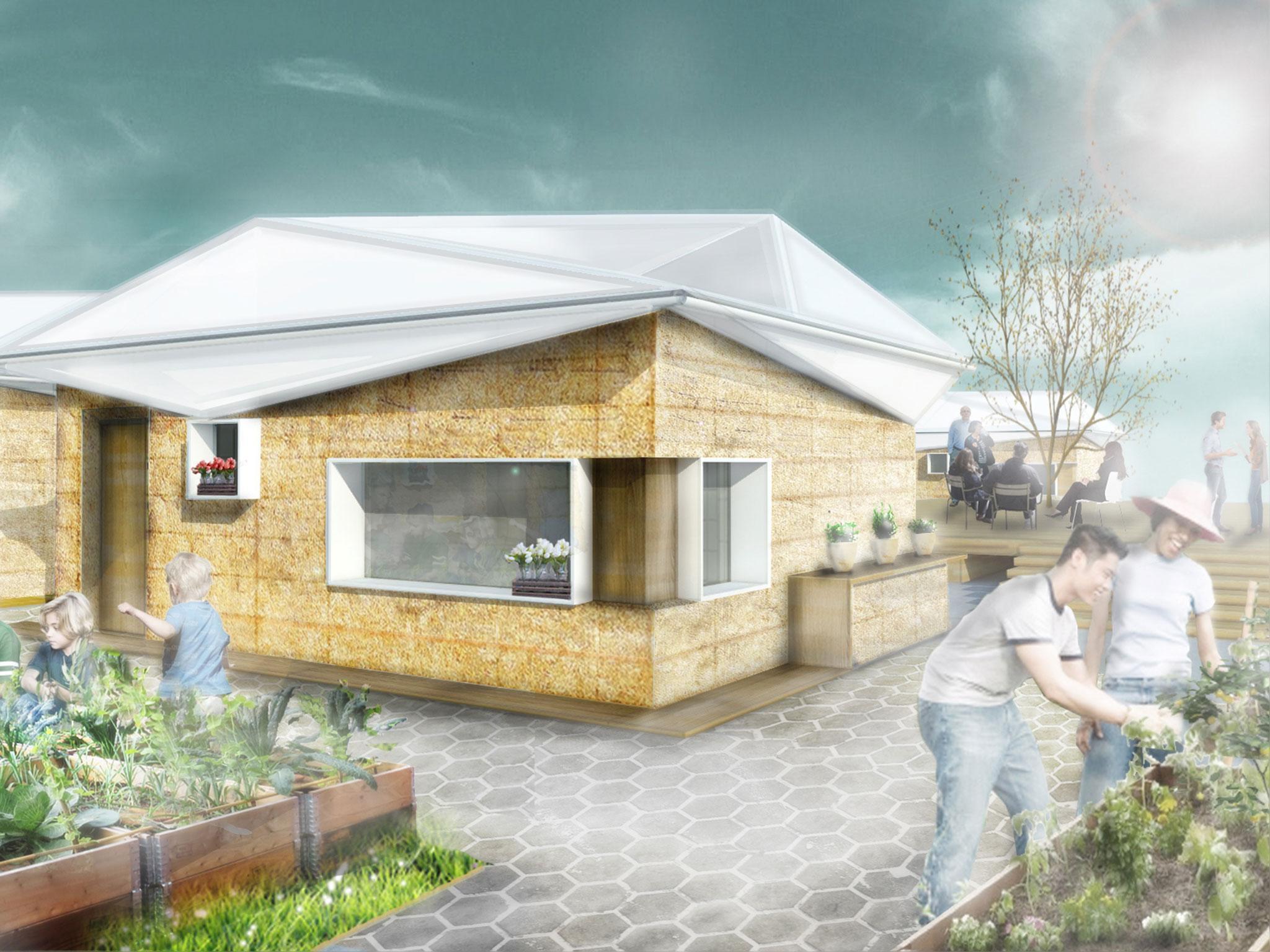
The Changing Futures European Network, meanwhile, helps connected refugees share their skills with academics and host communities; while the hexagonal Hex House is a low-cost home that is easy to put up and equipped with nifty features including solar panels and a rainwater harvest.
But how far can a quirky-looking shelter or a well-meaning app really go to fundamentally changing people’s lives for the better in the long term? How, if at all, can designers prevent their creations from being used by governments and international bodies as an excuse to leave the free market to sort out the lives of the world’s most desperate people? As evidenced recently in the clearing of the Jungle in Calais, some also argue that short-term solutions – such as temporary shelters – leave refugees in a worryingly precarious situation: their homes easily bulldozed or the threat used to dter others from following them.
“They [advances in design] should not be seem as ‘instead of’ but ‘in addition to’, and used in collaboration with governments, international organisations and refugees themselves to solve many of the problems that they face,” says Katherine Crisp, head of strategy and innovation at Unicef UK.
To point designers in the right direction, the organisation has compiled a set of principles: that the best design centres on the user; that it merges seamlessly into the context in which it will be used; and that it is open-source and is sustainable. But users are human, complex and unpredictable, so designs can often fail to hit the mark, particularly if creators don’t collaborate closely with future users. The igloo-shaped domes Oxfam gave those made homeless by the 1976 earthquake in Turkey, for instance, were unexpectedly used as chicken coops rather than for housing.
“Designers make enormous mistakes, looking at the problem from far away, with the prejudices that come with the media miscommunication and the difficulty of doing relevant and up-to-date need assessments,” says Clara Dalbera, a product design student at the Royal College of Art who visited the Jungle refugee camp in Calais 12 times to run workshops with migrants.
Still, a lot has changed since the 1970s. Design is now more focused on social change, and designers are more inclined to work with those whom they are serving. Perhaps more importantly, involving refugees changes them from being passive victims to active participants in creating their own futures, says Crisp. “And through these struggles can come tremendous innovation and solutions.”
Join our commenting forum
Join thought-provoking conversations, follow other Independent readers and see their replies
Comments